Science & Innovation
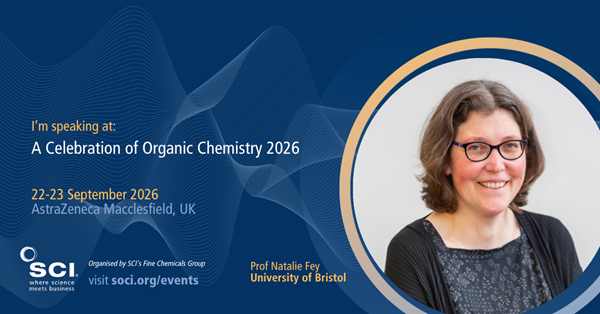
Ahead of the Celebration of Organic Chemistry event organised by SCI's Fine Chemicals Group, which takes place on 22nd and 23rd September at AstraZeneca's Macclesfield facility, organising committee chair Dr Christopher Jones asked some of the speakers about their careers so far and the current state-of-play in organic chemistry.
Natalie Fey is a Professor of Chemistry at the University of Bristol. Her group use computational approaches as a driver for scientific discovery, with a particular focus on organometallic catalysis. She completed her Ph.D. (2001) at Keele University, followed by postdoc positions with Rob Deeth (Warwick) and with Guy Orpen, Jeremy Harvey, and Guy Lloyd-Jones (Bristol). She was awarded an EPSRC Advanced Research Fellowship in 2007, appointed as lecturer in 2015, promoted to senior lecturer (2018), associate professor (2021), and professor in 2025. She is the programme director for Bristol’s programmes in Chemistry with Computing and an Associate Editor for Organometallics.
Here's what she had to say:
CJ: What do you think are the biggest challenges in your field and where do you see the most exciting advances being made in the next 20 years?
NF: I work in computational chemistry, using mechanistic calculations and data science approaches to inform and support synthesis, especially homogeneous organometallic catalysis. Our big challenge remains to put reliable prediction before synthesis, such that we can routinely recommend the best (or the best 5) catalysts to make a particular compound. Connecting synthesis and computation fully, with regular feedback loops for the validation of predictions, may sound a bit obvious, but it’s how we are going to achieve this.
CJ: What is the biggest change you have witnessed in the field of organic chemistry since starting your career?
NF: The routine use and integration of computational studies, and, more recently, the use of automation and HTE (High-Throughput Experimentation) to generate large datasets.
CJ: How do you see AI within organic chemistry?
NF: With a mixture of excitement and concern – when I started out, people were becoming very sceptical about DFT – a lot of people had had a go (perhaps badly) and been disappointed. I think we are about to fall off a hype curve with ML/AI in Chemistry. That doesn’t mean we can’t do good things with carefully trained and validated models, and there is some very good work taking place at the moment. But the initial rush has also produced some dodgy models and we’ll need to learn to distinguish between them, and to use the good things better.
CJ: Automated or manual column chromatography?
NF: Firstly, bleurgh, no! But actually, I used to like running a column so I could wander off and run my calculations (when I was still in the lab, I mostly made ferrocenes, which you could see coming off the column even from a distance). If an automation could just take that on, that’d be peachy… And if there’d been HTE, I might have lasted a bit longer in synthesis. In fact, I now have custody of an automated liquid handler (for teaching), which is great fun!
CJ: Which chemist do you most admire or has most influenced you?
NF: Some of the pioneers in applied computational chemistry (e.g. Jenny Green, Odile Eisenstein) made it look possible.
CJ: What would you prefer to do: a full day in the lab, or a full day writing a proposal?
NF: Running calculations is still my happy place!
CJ: What do you look for when hiring a new member for your team?
NF: Skills and the ability to articulate their views. Sometimes it’s a good thing if they can disagree with me (respectfully), too.
CJ: What would you be doing now if you weren’t a chemist?
NF: I would have liked to be an archaeologist, and I would probably have been the one making computer generated reconstructions of ancient sites. Or a palaeontologist, working out the bite force of a T-Rex from a computer model.
CJ: What one piece of advice would you have for a new PhD/postdoc/PI starting today?
NF: Nobody said it’d be easy…
Register for A Celebration of Organic Chemistry today at our early bird rate to hear Fey’s talk: ‘Guiding the selection of homogeneous catalysts with data’. She will be joined over the two days by a stellar lineup of other influential researchers, sharing the latest developments in organic chemistry.
Sign up here: https://soci.org/events/fine-chemicals-group/2026/a-celebration-of-organic-chemistry-2026
14 May 2026 |
|


 |
|