Science & Innovation
Continuing our series on Black pioneering scientists and inventors, we profile Garrett Augustus Morgan. His observations led him to upgrade the sewing machine, invent and upgrade life saving devices and develop personal care products for Black people, while championing civil rights and fighting for his own recognition.
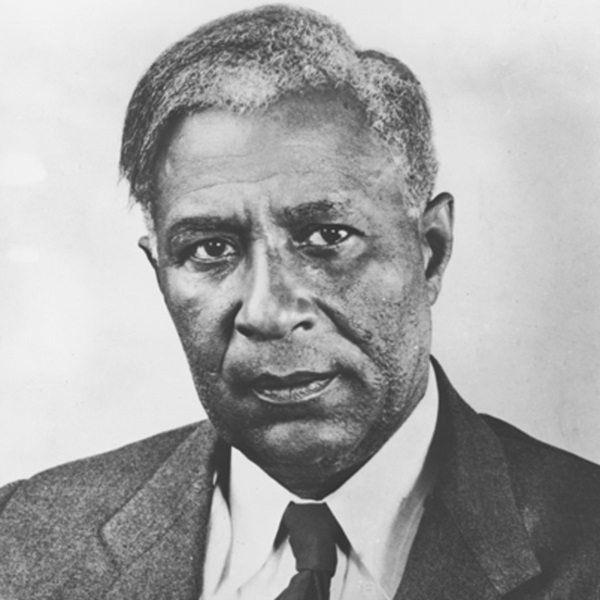
Garrett Augustus Morgan | Image credit: Public domain image courtesy of: https://www.dvidshub.net/image/1165661
Garrett Augustus Morgan was born in 1877, in Kentucky, US. Like many Black students he left school at a young age to find work. However, while working as a handyman in Cincinnati, he was able to hire a tutor and continue his studies.
During 1895, Morgan moved to Cleveland, Ohio, and it is said that Morgan’s interest in how things worked was sparked while repairing sewing machines for a clothing manufacturer. It was during this time that Morgan’s first inventions were developed: a belt fastener for sewing machines and the attachment used for creating zigzag stitching. By 1905, Morgan had opened a sewing machine shop and then a shop making clothes, ultimately providing employment for more than 30 people.
It was also during this time that Morgan became involved in the establishment of the Cleveland Association of Coloured Men. In addition to his interest in ‘gadgets’, Morgan also patented hair care products for Black people.
The life-saving Safety Hood
Morgan is credited with several inventions that have been responsible for saving many lives. In 1912 he filed a patent for the Safety Hood, which was developed after he had seen fire fighters struggling from the smoke encountered while tackling blazes. On the back of his invention, Morgan was able to establish the National Safety Device Company, in 1914, to market the product. While Morgan was able to sell his safety device across the US, it is said that on some occasions he hired a White actor to take credit for the device, rather than revealing himself as the inventor.
Morgan’s Safety Hood was soon in use in various settings including hospitals and ammonia factories. Indeed, the Safety Hood was used to save many lives and by the start of World War I, the breathing device had been refined to carry its own air supply. The Safety Hood was awarded a gold medal by the International Association of Fire Chiefs.
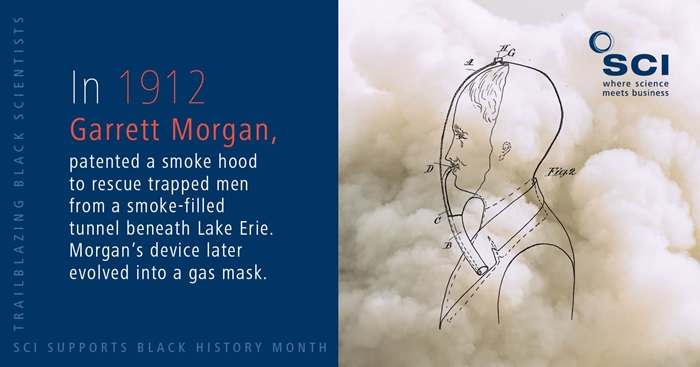
>> Read more about trailblazing Black scientists here.
Morgan’s device reached national prominence when it was used in the rescue of survivors and victims of a tunnel explosion under Lake Erie in 1916. The accounts tell of Morgan being woken early in the morning of 24 July 1916, after two rescuers lost their lives following the explosion.
Morgan is said to have arrived on the scene in his pyjamas, with his brother and a number of Safety Hoods. To allay the fears of the sceptics about his Safety Hood, Morgan went into the tunnel and retrieved two victims. Others joined and several people were rescued. Morgan is reported to have made four trips, but this heroism affected his health for years after as a result of the fumes he encountered.
Sadly, Morgan’s bravery and the impact of his Safety Hood were not initially recognised by the local press or city officials. It was some time later that Morgan’s role was acknowledged; and in 1917 a group of citizens presented him with the gold medal.
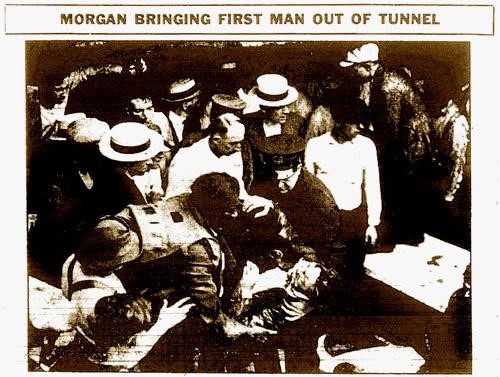
Garrett A. Morgan rescues a man at the 1917 Lake Erie Crib Disaster | Creative Commons CC BY-SA 3.0 Image in the Public Domain
While orders for Morgan’s device increased following the incident, it is said that when his picture appeared in the national press, crediting him as the Safety Hood inventor, officials in a number of southern cities cancelled their orders. Morgan is quoted as saying; ‘I had but a little schooling, but I am a graduate from the school of hard knocks and cruel treatment. I have personally saved nine lives.’
Safety seemed to be an important area for Morgan, as he became alarmed about the number of accidents that were occurring as cars became more prevalent in America. Along with the cars, bicycles, animal-drawn carts and people were sharing ever more crowded roads.
After witnessing an accident at a junction, Morgan filed a patent for a traffic light device which incorporated a third warning position. The idea for the ‘all hold’ position or what is now known as the amber light was patented in 1923. Morgan sold the idea to General Electric for $40,000 the same year. It should be noted, however, that a three signal system had been invented in 1920.
Morgan is credited with establishing a newspaper, building a country club open to Black people, and running for a seat on the Cleveland City Council, among many notable achievements. Morgan died in July 1963. He has been recognised in Cleveland Ohio, with the Garrett A. Morgan Cleveland School of Science, and the Garrett A. Morgan Water Treatment Plant being named in his honour. In addition, a number of elementary schools and streets carry his name.
29 October 2021 |
|


 |
|

Careers
Continuing our series on Black scientists, Dr George Okafo tells us about his journey from curious child, encouraged by family and mentors, to Global Director of Healthcare Data and Analytics with a leading pharmaceutical company.

What is your current position?
I am Global Director, Healthcare Data and Analytics Unit at Boehringer Ingelheim, and have been in this role for the past 10 months.
Right: Dr George Okafo
Please give us a brief outline of your role.
To build an expert team of data stewards, data scientists and statistical geneticists tasked with accessing and ingesting population-scale healthcare biobanks and then deriving target, biomarker and disease insights from this data to transform clinical development and personalise the development of new medicines.
What was it that led you to study chemistry/science and ultimately develop a career in this field? Was this your first choice?
My interest in science stems from my parents. My father was a medical doctor, and my mother was a senior midwife. As a child, I was always very curious and wanted to know why and how things worked. This curiosity has stayed with me all my life and throughout my career at GlaxoSmithKline and now at Boehringer Ingelheim. In my current role, I am still asking the same types of questions from Big Data and these answers could have a profound impact in the development of new medicines.
Was there any one person or group of people who you felt had a specific impact on your decision to pursue the career you are in?
Yes, my father and mother, who supported, encouraged and gave me the confidence to be curious, to keep trying and to never give up.

Dr Okafo held senior director-level roles in drug discovery and development while at at GSK.
Could you outline the route that you took to get to where you are now, and how you were supported?
My career journey started at Dulwich College (London) where I studied Chemistry, Biology, Maths and Physics at A Level. This took me to Imperial College of Science, Technology and Medicine (London), where I completed my Joint BSc in Chemistry and Biochemistry and my PhD in Cancer Chemistry.
I then spent a year at the University of Toronto in Canada as a Postdoctoral Fellow, before embarking on my career in the Pharmaceutical Industry, starting at GlaxoSmithKline (GSK). I spent 30 years at GSK, where I held many senior director-level roles in drug discovery and development. During my time, I made it my mission to learn as much about the R&D process and used this knowledge to understand how innovation can impact and transform drug research.
I have been very fortunate in my career to be surrounded by many brilliant and inspirational people who had the patience to share their knowledge with me and answer my many questions.
>> Curious to read more about some of the great Black scientists from the past? Here’s our blog on Lewis Howard Latimer.
Considering your own career route, what message do you have for Black people who would like to follow in your footsteps?
Surround yourself with brilliant people who can inspire you. Look for people who you respect and can coach and mentor you. Don’t be afraid to fail. Work hard and keep trying.
What do you think are the specific barriers that might be preventing young Black people from pursuing chemistry/science?
No, I do not see colour as a barrier nor a hindrance to pursuing a career in science. I think it is important to look for role models from the same background to help inspire you, to answer your questions and to encourage you.
What steps do you think can be taken by academia and businesses to increase the number of Black people studying and pursuing chemistry/science as a career?
Have more role models from different backgrounds. This sends a very powerful message to young people studying science reinforcing the message… I can do that!
Could you share one experience which has helped to define your career path?
Not so much an experience, but a mindset – staying curious, inquisitive, always willing to learn something new, having courage that failure is not the end, but an opportunity to learn.
11 October 2021 |
|
|
Careers
SCI has selected Harriet McNicholl from AstraZeneca as the 2021 National Undergraduate Placement Student of the Year.
The national undergraduate placement symposium brings together chemistry students undertaking industrial research placements each year. Students working in organic, biological, supramolecular, physical organic, medicinal chemistry and related fields are invited to submit posters. The finalists are then selected to present orally at the virtual symposium. This year’s applicants included students from organisations such as AstraZeneca, GlaxoSmithKline, UCB, Syngenta, Charles River and more.
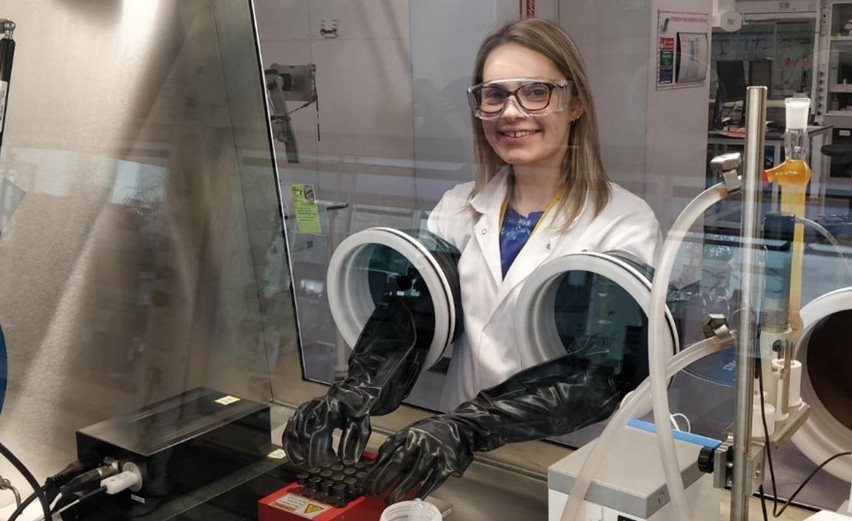
Harriet McNicholl’s chemistry will be used to manufacture drug products to support patients in phase-II clinical trials.
As part of this symposium, Harriet McNicholl from AstraZeneca was invited to present her research to develop a safe, inexpensive and commercially viable process towards AZD5991, a candidate therapeutic for the treatment of acute myeloid leukaemia.
Encapsulating AstraZeneca’s dynamic and data driven approach to turning molecules into medicines, Harriet highlighted how the SELECT criteria, automation and High Throughput Experimentation were used to design and optimise a process. Harriet’s work aimed to maximise efficiency and sustainability, and her chemistry will be used to manufacture drug products to support patients in phase-II clinical trials.
Harriet is in the third year of her chemistry integrated Master’s degree (MChem) at the University of Liverpool and is currently undertaking a synthetic chemistry industrial placement within Chemical Development (CD) at Macclesfield.
‘I have thoroughly enjoyed my placement year within Chemical Development at AstraZeneca,’ she said. ‘It has been incredibly rewarding knowing the science I’ve worked on has the potential to fundamentally transform oncology patients’ lives. This opportunity has enabled me to develop many of my technical and soft skills and motivated me to pursue a career within the pharmaceutical industry.’
Dave Ennis, Vice President of Chemical Development for AstraZeneca in Macclesfield, said: ‘Congratulations to Harriet who has made significant contributions to our development activities in Chemical Development. It is a reflection of the quality of students we attract to our sandwich student programme; I’m proud that we give our students a great insight to drug development by being active participants in our projects, and it is highly motivating for our scientists in helping to coach and develop others - a win-win for all involved.
‘Over the past 25 years, we have had a successful rolling programme of sandwich students from a variety of universities that has helped to attract the next generation of scientific talent to AstraZeneca and the wider industry. Looking forward to our next cohort in 2021, and I’m sure they will compete for the prize next year’.
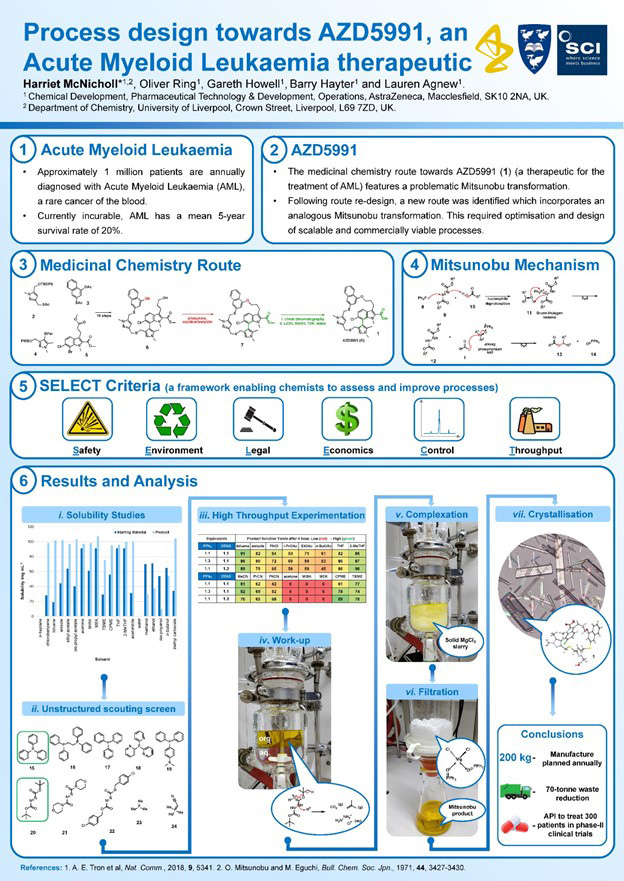
Harriet’s poster submission
Dr Andrew Carnell, Director of Year in Industry Courses at the Department of Chemistry in the University of Liverpool, added: ‘I am delighted that Harriet has been awarded this prestigious prize for her work during her placement at AstraZeneca. She is a credit to the department and to the university. Our Year in Industry students gain a huge amount from their placements, not only in terms of practical experience and technical knowledge but increased confidence and employability. Students return to us highly motivated for their final year and often go on to secure excellent and rewarding positions in today’s competitive job market.’
As part of this event, keynote speaker James Douglas (Manager of AstraZeneca’s Catalysis, High Throughput and Synthesis Technologies team) noted that his career journey started with a placement year at GlaxoSmithKline in Stevenage. James went on to describe the benefits of doing a placement year and how the skills he gained from his year in industry helped him to secure a Ph.D. at the University of St Andrews and a postdoctoral position with Eli Lilly in the United States.
This year’s competition featured many strong entries. Congratulations to runners up Daniella Hares (AstraZeneca, University of Southampton) for her presentation outlining computational techniques for drug discovery and poster prize winner Jake Odger (Sosei Heptares, University of York). The competition was hosted and organised by the Society of Chemical Industry Young Chemists’ Panel
For more on this year’s National Undergraduate Placement Student of the Year competition, visit: https://istry.co.uk/postercompetition/4/
22 July 2021 |
|
|