
The Nobel Prize in Physiology or Medicine 2026 has been awarded to three researchers for their work on optogenetics, which makes it possible to control the activity of nerve cells in a living brain, using light.
The ability to activate individual types of nerve cells has helped scientists to develop their understanding of how the brain works, identifying circuits that govern the sense of pain, social behaviours, thirst and more. It has also provided greater understanding of the distinguishing features of psychiatric and neurological disorders such as depression, anxiety and schizophrenia. Researchers have also taken the first steps towards using optogenetics as a medical treatment.
Peter Hegemann and Georg Nagel discovered a protein – channelrhodopsin - in a single-celled alga, while Karl Deisseroth transformed the protein into a light-controlled switch for nerve cells, according to the Nobel Assembly at Karolinska Institutet, which awards the prize. Through this work, it said, the three laureates "have laid the foundation of a new era in neuroscience."
The prize was awarded to the three for "their discoveries concerning light-gated ion channels and optogenetics”
Per Svenningsson, chair of the Nobel Committee for Physiology or Medicine said: “Optogenetics provides opportunities for mapping the brain in a way that we could once only dream of."
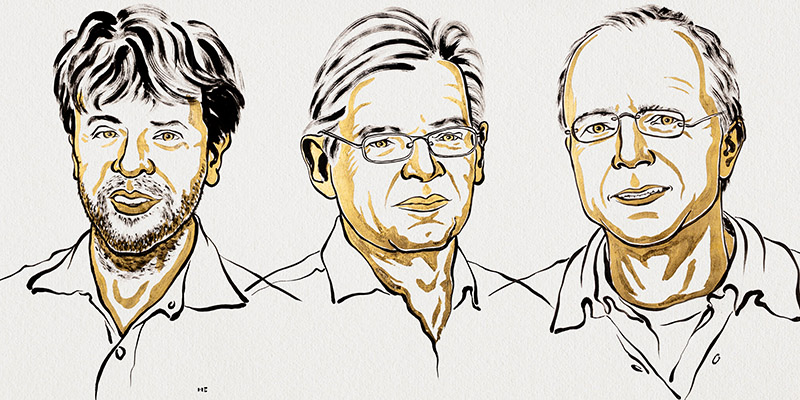
Above: left to right, Karl Deisseroth, Peter Hegemann and Georg Nagel. Image: Ill. Niklas Elmehed © Nobel Prize Outreach
Hegemann investigated how Chlamydomonas, a single-celled alga, was able to swim towards a light source. In the early 2000s, along with Nagel he discovered channelrhodopsin, an algal protein, on the surface of the cell. When illuminated by blue light, a channel opens through the protein and charged ions then flow into the cell, creating an electrical impulse. Hegelmann and Nagel found that regardless of which cell they put the protein in, those cells became light sensitive.
Deisseroth introduced the gene for channelrhodopsin into nerve cells from rats. By illuminating the cells with blue light, he was able to trigger a nerve signal, publishing this research in in 2005, and then going on to make the light-controlled switch for nerve cells work in the brains of mice.
“This method for controlling nerve signals with light is now called optogenetics, and it has rapidly gained global impact. Using optogenetics, researchers have been able to reveal neural circuits governing specific memories, feelings, and behaviours relevant for neurological and psychiatric disorders,” the Nobel Assembly said: “Optogenetics has fundamentally altered our understanding of the brain.” The three share the prize of 12 million Swedish kronor (about $1.2 million).
Further reading
- Project to decode human ageing reaches major milestone
- How sugar from space could be a clue to the origins of life on Earth
- Boosting brain plasticity [Premium]
Chemistry & Industry (C&I) magazine reports on the people, the scientific advances and the industrial innovations being harnessed to tackle society's biggest challenges. C&I covers advances in agrifood, energy, health and wellbeing, materials, sustainability and environment, as well as science careers, policy and broader innovation issues. C&I’s readers are scientific researchers, business leaders, policy makers and entrepreneurs who harness science to spark innovation.
Get the latest science and innovation news every month with a subscription to Chemistry & Industry magazine. You can subscribe to C&I here.
 Visit Blog