
Kabeer Abdulhusein was awarded a Rideal Travel Bursary to attend the Gordon Research Conference (GRC) on Electronic Processes in Organic Materials held in Lucca, Italy. Here he tells us about his highlights from the conference.
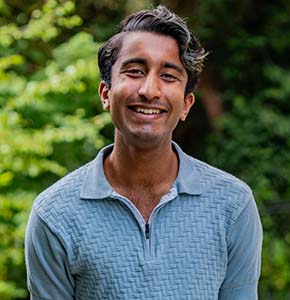
"The conference programme consisted of a two-day Gordon Research Seminar (GRS), followed by the main week-long conference. As one of the leading events in the field of organic electronic materials, and one that takes place only every other year, it was an invaluable opportunity for me to interact with researchers working at the forefront of the discipline.
"I was fortunate to be selected as a speaker at the seminar, where I presented my research on unexpected conjugated polymer assemblies revealed by scanning tunnelling microscopy. My work combined novel insights into the two-dimensional packing of semicrystalline polythiophene-based materials with the direct visualisation of conjugated polymer tie-chains; a phenomenon that, until now, had existed only in theoretical models.
"Presenting my research proved highly beneficial. As a direct result of my talk, I was approached by some academics and numerous early-career researchers throughout the event. Some discussions focused on how my findings could help explain observations from their own research, where our nanoscale imaging results complemented their macroscopic measurements to build a more complete understanding of the behaviour of the pBTTT polymer. Others were interested in how our approach, preparing and imaging polymer monolayers to sequence defects and investigate structural conformations, could be applied to address questions within their own polymer systems. These conversations have provided an excellent foundation for future collaborations.
"The conference covered a broad range of topics, spanning the synthesis and characterisation of conjugated materials, perovskites, and device fabrication. The diverse programme of talks and posters helped place my own research within the wider landscape of advances in organic electronics, demonstrating how it contributes to the cutting edge of knowledge in the field. Of particular interest were discussions surrounding the automation of data acquisition and analysis. Learning how another research group had successfully automated a workflow for analysing domain orientation in transmission electron microscopy studies gave me confidence in our own efforts to incorporate machine learning and computer vision techniques into our lab’s research.
"Perhaps the most valuable outcome of the conference was the opportunity to spend time discussing science, ideas, and experiences with fellow attendees. Building this professional network has strengthened my position within the field, allowing me to establish connections not only with leading academics but also with postdoctoral researchers and fellow graduate students working on similar scientific challenges. This networking aspect is one of the greatest strengths of the GRC, which fosters meaningful interactions through a diverse programme of activities extending well beyond the formal lecture schedule.
"As my first experience of both a major international conference and a Gordon Research Conference, the support provided by the Rideal Travel Bursary has been particularly impactful. It allowed me to explore potential career paths involving advanced surface-characterisation techniques within the field of organic electronics while gaining valuable exposure to a global research community.
"Overall, I have benefited immensely from the opportunity to attend the Electronic Processes in Organic Materials GRC and GRS. Presenting both a seminar talk and two posters contributed significantly to my professional development, enabling me to form meaningful and lasting connections while further strengthening my ambition to pursue a career in academic research."
Kabeer Abdulhusein
PhD student
University of Birmingham
 Visit Blog