Wojtek Treyde was awarded a Messel Travel Bursary to attend to attend the Computational Chemistry Gordon Research Seminar and Conference held in Barcelona, Spain. Here he tells us about his highlights from the conference.
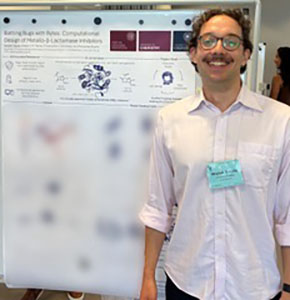
"The motto of this year’s GRS was “Physics-Based and Data-Guided Methods for Molecular Modelling”. The talks highlighted the interplay between traditional physics-based simulation and emerging machine learning approaches, as well as the new opportunities that this creates for drug discovery and materials design. The GRS comprised three scientific sessions and two poster sessions. It began with “Computing Molecular Behaviour: Developments in Physics-Based Molecular Modelling”, which covered recent progress in physics-based simulation. The second session, “Learning from Data: AI and Hybrid Molecular Modelling”, explored approaches that combine physics-based methods with machine learning and AI, including the use of chemistry language models, machine-learned interatomic potentials (MLIPs) and hybrid modelling frameworks. I was pleased to serve as discussion leader for the third session, “Translating Computation into Discovery”, which felt particularly relevant to my own work on computational chemistry and machine learning for antibiotic discovery. In that session and throughout the seminar, I appreciated the lively discussions, where participants were encouraged to ask questions and challenge assumptions. This made the meeting feel highly interactive rather than purely lecture-based. I also presented my DPhil research on the computational design of metallo-β-lactamase inhibitors as a poster at both the GRS and the GRC, giving me the chance to share my work with peers, receive early feedback and contribute actively to the meeting.
"The motto of this year’s GRC was “Molecular Discovery and Simulation in the AI Era”. The conference featured nine sessions spanning foundational methodology and applications across chemistry, biology and drug discovery. The opening keynote session, “Atomic-to-Cellular Simulation of Biochemical Structure and Function”, led by Andrew McCammon, a pioneer of computational biophysics and molecular dynamics simulations, set the tone for the week. I especially enjoyed Adrian Roitberg’s keynote on the past, present and future of molecular dynamics and MLIPs, and Frank Noe’s discussion of how AI can emulate physics-based simulations. The following sessions on next-generation methods, protein simulation and dynamics, AI and the future of molecular design, enhanced sampling and rare events, multiscale simulation of molecules and biomolecular assemblies, and integrative modelling and protein design provided a broad view of how the field is evolving. Talks by Gábor Csányi on recent progress of his group’s MLIPs, Mario Motta on quantum computing for quantum chemistry, Tess Smidt on Euclidean neural networks, and John Chodera, Terra Sztain, Michael Gilson and Michael Shirts on the relationship between AI, physics and molecular design were especially thought-provoking. I also found the session on integrative modelling and protein design particularly compelling because Silvia Osuna and Bruno Correia demonstrated interesting applications of physics-based and AI-based protein design, strengthened by extensive wet-lab validation.
"As a DPhil student developing computational chemistry and machine learning methods for antibiotic discovery, attending both meetings was extremely valuable. The conference broadened my understanding of the latest unpublished advances in molecular simulation, data-driven modelling and AI-driven drug discovery, and it helped me place my own research within this rapidly evolving landscape. The GRC’s emphasis on in-depth discussion, poster sessions and informal scientific exchange was especially beneficial because it allowed me to discuss ideas, receive constructive feedback and learn from both established leaders and fellow early career researchers. Serving as a discussion leader at the GRS was also a valuable professional experience, as it strengthened my ability to facilitate scientific discussion and engage confidently with researchers from different backgrounds. More broadly, attending these meetings has improved my career prospects by giving me greater visibility within the computational chemistry community and by helping me build relationships that will be important as I progress through the next stage of my career. The insights I gained will directly inform my current research, particularly in how I think about integrating physics-based modelling, machine learning and experimental validation into the design of new antibiotic candidates. I am very grateful to the SCI for its generous financial support through the Messel Travel Bursary, which made my attendance possible."
Wojtek Treyde
PhD researcher
University of Oxford
 Visit Blog