
Discovering new small molecules is a long, and time consuming, process. But a new company thinks that a novel approach to chemistry, combined with artificial intelligence, could be the key to speeding up the process significantly.
Small molecules built primarily from carbon-carbon bonds are used across everything from drugs, to novel materials and agricultural products. And while AI has the potential to transform the discovery of new molecules, it also requires a way to make and test new small molecules in multiple assays fast enough to feed data back to the algorithms so that they can then optimise the recipe further.
Excelsior Sciences, based in New York, US, argues that previous attempts to automate this process have failed because they replicate the traditional ‘artisanal’ approach to chemical synthesis. In contrast, the company has developed what is describes as machine-friendly chemistry, based on synthesis-friendly chemical building blocks called 'smart bloccs'.
The smart bloccs are molecules, modularised in a way that they can be snapped together and purified using Excelsior’s chemistry to come up with a completed molecule. By combining these building blocks with AI, Excelsior says it can increase the pace of the design, make, test, analyse cycles for new molecules.
The company recently announced that it has raised $95 million: the financing comprising a $70 million Series A, co-led by Deerfield Management, Khosla Ventures, and Sofinnova Partners, as well as a $25 million grant from New York’s Empire State Development.
“One of the things that has always interested me is - how do you speed up drug discovery?,’ Brian Goldman, vice president of AI and data sciences at Excelsior, told C&I. ‘There is a whole wealth of beautiful computer science theory that you can apply, but when it meets the real world of drug discovery, the problem is making the actual molecules that your algorithms suggest.
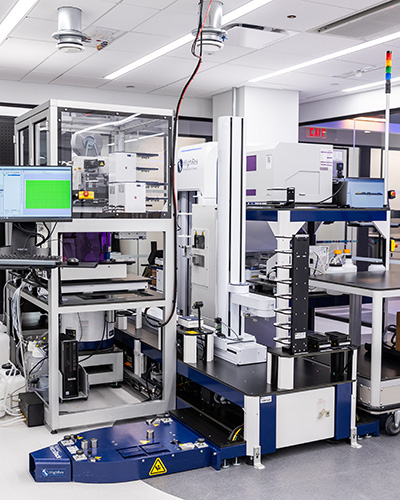
‘So that's one of the main things that excites me about Excelsior, it is this continual loop, and the fact that the platform is designed to iterate and explore novel chemotypes, many at a time,’ he says.
The company is also taking a slightly different approach to AI than some other companies using it for drug discovery. Often generative AI design is used to attempt to generate molecules with a particular property – which can then create problems when chemists have to try to actually synthesise the molecule.
Excelsior takes the approach of using a discrete generative design process based on what can be synthesised on its machines via smart bloccs to create molecules optimised for particular properties.
‘So the differentiating factor is that we can access an enormous space of chemistry, [and] run a machine learning algorithm over that space to discretely generate or select molecules from that space, that can then be made on our synthesis machine,’ he says. ‘So the velocity, combined with the unique discrete nature of our space is the differentiating factor that allows us to iterate and optimize,’ Goldman says.
Jana Jensen, co-founder and COO at Excelsior says it’s the maturation of the underlying chemistry that is the key to this development because it had reached the point at which it can be industrialised and used to automate chemistry in the lab in a robust fashion when combined with AI. ‘And we recognized that, essentially, this is a new way to look at chemistry, to break chemistry down, that is ideal for AI to learn from.’
Excelsior plans to invest in its own internal pipeline and build partnerships across a range of industry sectors, including therapeutics and materials science. The company’s launch comes as the pharmaceutical industry in the US is under pressure to secure supply chains; the company said one of its aims is to make reshoring affordable for both discovery and manufacturing.
Further reading
- Ten scientific breakthroughs getting ready to change the world
- Quantum technology is reaching a commercial tipping point for chemicals and pharma
- New catalysts can take 20 years to develop. This project wants to do it in five
- $1.5B NSF X-Labs initiative seeks 'transformative' science breakthroughs
- 25 deep tech innovations that could shape the future
Chemistry & Industry (C&I) magazine reports on the people, the scientific advances and the industrial innovations being harnessed to tackle society's biggest challenges. C&I covers advances in agrifood, energy, health and wellbeing, materials, sustainability and environment, as well as science careers, policy and broader innovation issues. C&I’s readers are scientific researchers, business leaders, policy makers and entrepreneurs who harness science to spark innovation.
Get the latest science and innovation news every month with a subscription to Chemistry & Industry magazine. You can subscribe to C&I here.
 Visit Blog