
For forty years, SCI has supported and recognised the excellence of early career scientists, by aiding their studies in the form of an SCI Scholarship.
Since 1985 more than 80 scholarships have been awarded which have not only given the recipients financial assistance, but have enabled them to broaden their network, and strengthen their skills and knowledge. SCI Scholars receive access to publishing and mentoring opportunities and are given a platform to present their work amongst esteemed scientists and industrialists, raising their profile within the scientific community.
Harry Kay was awarded an SCI Scholarship in 2025. At the end of their scholarship, SCI Scholars present a report to SCI. Read on to find out what he has done in his first year as an SCI Scholar.
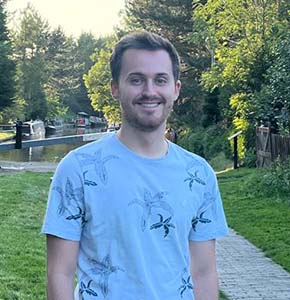
"To address this challenge, my research proposes a methodology that integrates physics-informed machine learning, hybrid modelling and uncertainty quantification techniques to construct high-fidelity digital twins for (bio)chemical processes. By applying these modelling techniques, we can accelerate process development across increasing scales whilst operating under low experimental budgets by exploiting model-based design of experiments. Additionally, the developed tools can be deployed to assist with online and offline decision making, supporting more sustainable operation and design of novel and existing processes.
"During the past year, the SCI scholarship enabled several important milestones. I first-authored a publication on developing a hybrid modelling framework for enhanced prediction in chemical reaction kinetics and presented this work at the Advances in Process Analytics and Control Technologies conference in Glasgow. I also presented a poster at the RSC Process Chemistry and Technology conference in Leeds on automated reaction network identification; this work has been submitted as a first-author publication and is currently under review. The scholarship further supported a one-month research collaboration at the University of Southampton and attendance at the 2nd Berlin-BioTECH Symposium, which supported an ongoing collaboration with TU Berlin. Together, we recently integrated interpretable data-driven modelling with a laboratory robotics system to complete a fully autonomous experimental and model construction procedure for an enzymatic reaction network.
"Later this year, I will present my research at EuroPACT 2026 in Lyon and ESCAPE 36 in Sheffield. My future work will focus on analysing automated reaction mechanism generation methods for complex reaction networks and developing kinetic models with robust uncertainty analysis, with the long-term aim of validating the results within an industrial environment.
"I am extremely grateful to the Society of Chemical Industry for their support, which has accelerated my technical development, enabled valuable collaborations, and expanded my professional network during my PhD, under the supervision of Dr Dongda Zhang at the University of Manchester. I look forward to continuing my engagement with SCI in the years ahead."
Harry Kay
PhD Student
The University of Manchester
 Visit Blog