
A team of US researchers has developed the first synthetic cell that replicates the life-cycle of a biological cell.
The team in the College of Biological Sciences at the University of Minnesota believes the cell, built entirely from non-living chemical components, offers a complete life-cycle and as such the project, known as SpudCell, could represent a major breakthrough in biological engineering (bioRxiv, 2026, DOI: 10.64898/2026.07.01.735724).
The SpudCell is capable of selection, genome replication, growth, resource acquisition through feeding and genetically encoded division.
The cell is encoded with a 90 kilobase pairs (kbp) genome that includes functions needed for these cell functions. Cell division in natural cells, for example, is achieved using internal scaffolding, known as a cytoskeleton, which has been a bottleneck in synthetic cell research, according to the researchers. SpudCell overcomes this obstacle with proteins that aggregate on the membrane surface until mechanical stress splits the membrane.
Biologists have previously speculated that the genome for a living cell could be as small as 113kbp but the 90kb genome for SpudCell is much smaller (and tiny compared to the human genome’s 3m kbp). In SpudCell, rather than a single chromosome, the genome is split across seven separate DNA plasmids. This modular structure is to allow the team to ‘programme’ various cell functions independently. The researchers introduced a genetic change that increased production of the fusion protein, resulting in cells that grew faster and produced more offspring.
‘After five generations, the faster growing variant had outcompeted the original. Under nutrient scarcity, the advantage increased, demonstrating selection and competition operating in a fully synthetic chemical system,’ the team said.
The team points out that most drugs, materials and industrial chemicals require molecular transformations that are currently achieved either by using natural cells or using other chemicals, often with high energy costs. Cells built from scratch like this could perform transformations that are not currently achievable with industrial chemistry. This could include therapeutic molecules that incorporate amino acids that have never been used before and materials that are grown rather than synthesised, as well as manufacturing processes that operate at biological temperatures.
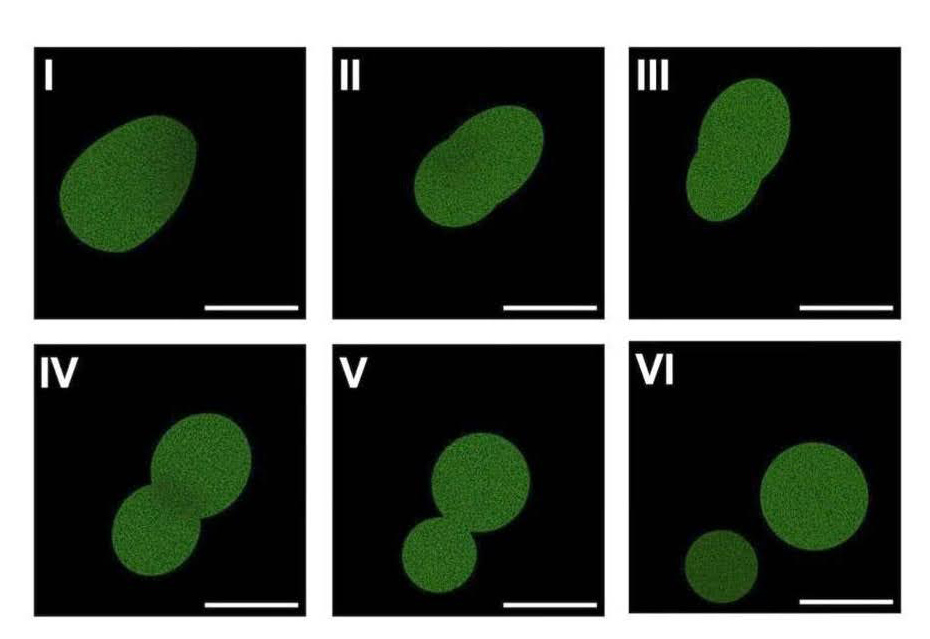
Above: Fluorescent microscopy of SpudCell undergoing division. Credit: Kate Adamala, Adamala Lab
Lead researcher Kate Adamala said: ‘We’ve replicated in chemistry what only used to be possible in biology: the complete set of behaviours of a cell. It proves that the most fundamental functions of life, like growth and replication, do not need a mysterious magical spark.’
Adamala and other colleagues outside of the university are launching Biotic, a public-benefit research and engineering institution, which aims to build the shared technical infrastructure for synthetic cell engineering. This will be open for the participation of other researchers.
‘This work is just the beginning,’ says Adamala . ‘We are showing it’s possible to engineer the basic functions of the cell. To full realise the promise of this technology – to make it robust and practical – we need combined international effort. The role of Biotic will be to focus engineering efforts and make them compatible with a shared chassis. SpudCell is that chassis, and with Biotic setting the protocols for collaboration, we are eager to start applying this technology to serious challenges.’
To produce an engineering pipeline, the SpudCell’s separate plasmids need to be consolidated into a single, stable genome, according to the researchers, and further molecular machinery needs to be built. The team believes there is also an infrastructure challenge as different labs do not have shared standards for a working cell. ‘This was exceptionally difficult work to scale,’ says Adamala. ‘The knowledge in this space is very hard to explain, so we had collaborators on the project fly in for in-person demonstrations just to get particular techniques working. That’s not scalable. Any engineering discipline needs modularity. In our case, we believe those modules must be build in the open: an infrastructure foundation built privately just gives someone a toll booth.’
Now read this:
- New catalysts can take 20 years to develop. This project wants to do it in five
- Quantum technology is reaching a commercial tipping point for chemicals and pharma
- Creating chemistry that machines can understand
Chemistry & Industry (C&I) magazine reports on the people, the scientific advances and the industrial innovations being harnessed to tackle society's biggest challenges. C&I covers advances in agrifood, energy, health and wellbeing, materials, sustainability and environment, as well as science careers, policy and broader innovation issues. C&I’s readers are scientific researchers, business leaders, policy makers and entrepreneurs who harness science to spark innovation.
Get the latest science and innovation news every month with a subscription to Chemistry & Industry magazine. You can subscribe to C&I here.
 Visit Blog