
Scientists have grown wheat containing ‘super-sized’ starch granules, a development which they say could have a have potential benefits for diet, as well as industrial applications.
Granule size has a major influence on how starch is digested, the researchers in the Seung Group at the John Innes Centre said. Larger granules digest more slowly because they have less surface area available for digestive enzymes. Starch that resists digestion in the upper gastrointestinal tract and is processed in the lower gastrointestinal tract benefits the gut microbiome and helps avoids sudden blood sugar spikes.
Larger starch granules offer benefits in paper manufacturing and packaging because larger granules are easier to separate, making processing easier. Other industries that might benefit could include pharmaceuticals, cosmetics, textiles, and biochemicals, the researchers said.
The John Innes Centre team investigated how to develop durum wheat that would yield starch with larger A-type granules. Two cellular factors limit starch granule size: the space available for granule growth in the amyloplast - the storage space for starch in wheat grains - and the number of granules that compete for growth substrates. The researchers sought to create wheat with a larger starch storage space and fewer competing granules.
The research is published in Science Advances, and notes that space and substrate constraints limit starch granule size in wheat - and provide an approach to achieve substantial increases in granule size. “Overall, by targeting both constraints, we created a giant cereal starch that has not been observed in nature, with altered physicochemical properties that can be used in food and industrial applications,” the paper said.
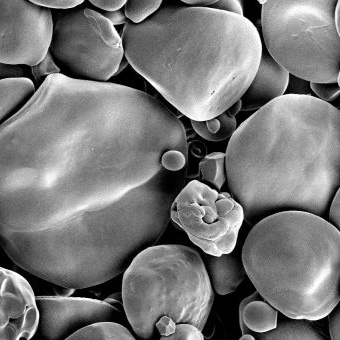
The researchers said that scanning electron microscopy imaging confirmed that the experimental wheat plants produced A-type starch granules that were up to 50 micrometers in size, more than double the typical size of 20 micrometers. More than half of the granules were 30 micrometers in size, compared to just six percent in regular wheat starch. (Image left, courtesy John Innes Centre, shows the super-sized wheat starch granules created by engineering a larger starch storage space and fewer granule initiations).
“We were hoping our hypothesis would be correct, that with both a larger space to grow and less competition for substrate we would get bigger granules – but we were totally surprised by quite how big the new granules were. We even needed to adjust the aperture on the particle size analyser to capture the full scale,” said Rose McNelly, first author of the study.
The team selected wheat plants with mutations in the two genes controlling amyloplast size and granule initiation and then breed new double mutant plants combining both these traits. The aim of the Seung group, and colleagues at Quadram Institute, is to create pasta made from plants containing these larger starch granules and test them in human trials to see if they are resistant to digestion with all the benefits that follow.
Dr Fred Warren a group leader at Quadram Institute and a co-author on the paper said: “By generating foods such as pasta from this material we can explore if there is the potential to gain benefits such as reduced post-prandial glycaemia or improvements in gut microbial diversity from consuming these engineered starches.”
Further reading
- Building resilient food systems: The international outlook
- Bioeconomy boost as Europe unveils three new initiatives
- Boosting biscuit nutrition with green banana flour
- Sustainability in the vineyard: Wine from fungus-resistant vines
Chemistry & Industry (C&I) magazine reports on the people, the scientific advances and the industrial innovations being harnessed to tackle society's biggest challenges. C&I covers advances in agrifood, energy, health and wellbeing, materials, sustainability and environment, as well as science careers, policy and broader innovation issues. C&I’s readers are scientific researchers, business leaders, policy makers and entrepreneurs who harness science to spark innovation.
Get the latest science and innovation news every month with a subscription to Chemistry & Industry magazine. You can subscribe to C&I here.
 Visit Blog