BY STEVE RANGER
The tools used by scientists to explore the mysterious universe around them have always changed and evolved – ever since our curiosity outran the basic capabilities of our senses. Scientists have mostly always welcomed advances that allow them to see further and more clearly, or to explore faster, and also often themselves played an important part in inventing or developing those tools.
A visit to Philadelphia’s Science History Museum was a great reminder of how the tools of science have developed. The antique test tubes of the nineteenth century were augmented by the bulky industrial machines, replete with heavy switches and dials, of the twentieth century, and ultimately by today’s high-powered computing and satellite data.
The reason for the trip to Philadelphia was to attend SCI America’s Innovation Day, which brought together early-career professionals from across the industry to meet and network with industry leaders.
Designed as an opportunity to understand the issues that are shaping the industry, this year the spotlight was on the latest tool to be added to the scientific kit: artificial intelligence.
There was certainly a lot to talk about. Breakthroughs in AI usage promise to have an impact on everything from basic research through to materials and drug discovery, lab work and more.
There are already plenty of examples of the impact AI is having. So far AlphaFold, developed by Google DeepMind, has predicted over 200m protein structures and has over 3m users from over 190 countries. Most recently protein structure predictions for thousands of viruses, which could improve the response to future outbreaks, were added to the database. Demis Hassabis and John Jumper shared in the 2024 chemistry Nobel for their work on developing the models.
There’s also some evidence that AI tools can play a more active role in discovery too. Last month, Anthropic announced that its Claude AI had identified the features of what is said was a ‘previously uncharacterised’ enzyme system associated with an array of DNA repeats, a pattern reminiscent of Crispr.
Anthropic noted that while the function of the system hadn’t been established, it has a set of characteristics that have only ever been found together in a handful of other systems, all of which are programmable and perform operations like cutting, copying, and pasting DNA.
Anthropic CEO Dario Amodei on X said the significance of the discovery is still unclear but noted: ‘At a minimum it is work I would have been proud to do as a PhD student.’
He even held out the prospect of Claude ‘eventually’ performing experiments by autonomously controlling lab equipment.
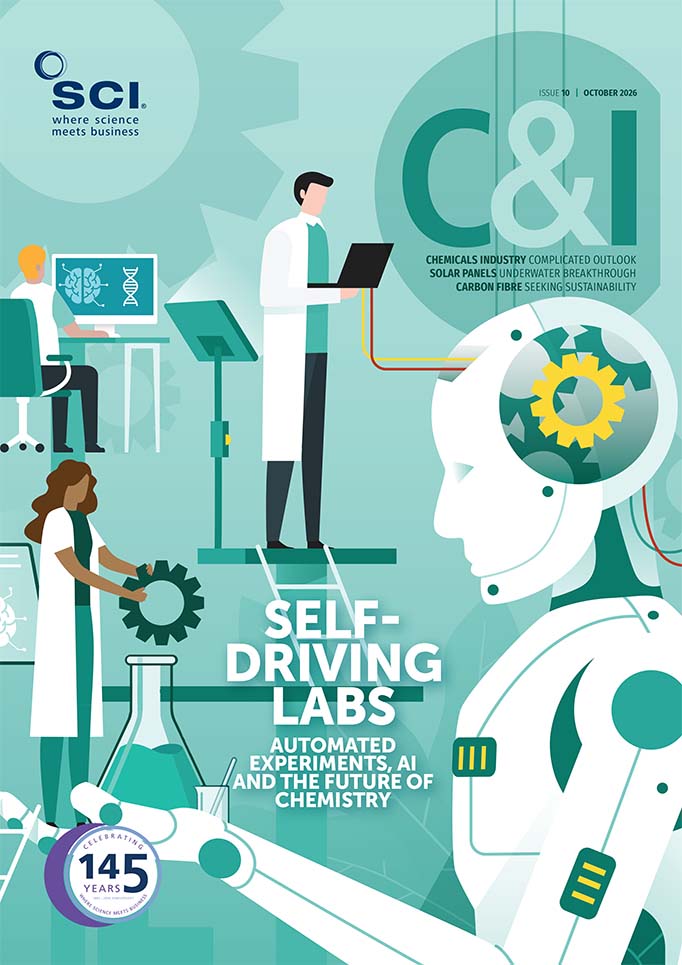
Indeed, another area of development is the emergence of what are known as self-driving labs – systems that use a combination of robotics, automation, machine learning and AI to speed up scientific discovery.
In these systems, scientists set the objectives, and the system is then able to perform experiments automatically. You can read more about self-driving labs in our in-depth report on page 30.
Much of the discussion at the Innovation Day looked at the skills that can help scientists to thrive in a workplace that is being redefined by new technologies. The conversations focused on two questions: what AI means for chemistry and what AI means for jobs in chemistry. I think there was a sense that, right now, the outlook is positive for both.
There was much agreement that AI will reduce some of the bureaucracy of scientific research. Literature searches and data gathering could become easier. Meanwhile the chemical industry currently faces huge challenges when it comes to sustainable growth and retaining the institutional knowledge of staff who are ageing out of the workforce. AI is already playing a part in capturing that knowledge and making it available to newer staff in a usable form.
So, what skills will be most useful in the new era of AI-infused chemistry? The Innovation Day attendees had plenty of ideas. The technical and scientific skills are still essential – of course – but they won’t be enough on their own.
At the top of the list of skills required are curiosity and the humility to recognise that we do not know everything – and that some of what we think we know may be wrong. Critical thinking, adaptability and flexibility will also be essential, as will be resilience when things do not go to plan, along with sound decision-making and the ability to weigh competing options.
On top of that: future scientists will need creativity, communication skills and storytelling abilities. The ability to understand the needs of others, and the ability to sell a vision will be critical. For example, regardless of how AI augments our labs, one will still need to persuade a boss of the need for more research or to sell a fresh innovation to a customer. I’d add a couple more: optimism and agency. Chemistry is not short of big questions and big challenges. If new tools help us answer questions and solve problems, then we should seize the opportunity.
 Visit Blog