BY NAGEEN MATLUB
The World Polymer Congress is one of the most important international gatherings in polymer science and is organised biennially by the Polymer Division of the International Union of Pure and Applied Chemistry (IUPAC).
In July, a team from SCI and its journal Polymer International travelled to Kuching, Malaysia, for IUPAC MACRO 2026, the 51st World Polymer Congress. Bringing together polymer scientists from across the globe, the congress offered an important opportunity to celebrate excellent research, reconnect with familiar faces and establish new relationships across the international polymer community.
SCI’s relationship with IUPAC stretches back to the organisation’s foundation in 1919. More than a century later, that relationship continues through SCI’s engagement with the IUPAC Polymer Division, the Polymer International–IUPAC Award and a shared commitment to supporting international scientific exchange.
This year’s congress theme ‘New polymers and innovative materials for a sustainable future’ brought together fundamental and applied research across areas including polymer synthesis, green processing, circularity, clean energy and environmentally responsible materials.
The focus on translating scientific advances into wider benefits made the event a natural setting for SCI, with its mission to connect science with industry and society. The event in Kuching was also significant as this is only the second time the congress has been hosted in Southeast Asia, reflecting the growing influence of Malaysia and the wider region within the global polymer and materials community.
One highlight of the week was the presentation of the tenth Polymer International–IUPAC Award to associate professor Anindita Das of the Indian Association for the Cultivation of Science.
The award recognises outstanding researchers in polymer science, following a competitive selection process involving internationally recognised scientists and members of the journal’s editorial board.
Anindita delivered an award keynote during the congress, sharing her research with an international audience. Her involvement demonstrated what we hope the award can achieve: recognising scientific excellence while helping researchers build international connections and share their work more widely.
An important part of attending an international congress is also what happens outside the formal scientific programme. Our participation in the congress gala dinner provided an informal opportunity to spend time with editorial board members, IUPAC representatives and researchers from across the global polymer community. Meanwhile the SCI–IUPAC networking reception provided another friendly space for researchers, editors and representatives from the international polymer community to meet.
It was lovely to see established colleagues reconnecting, while new introductions quickly developed into conversations about research, publishing and future opportunities. The reception received positive feedback and demonstrated the value of creating time and space for conversations beyond the busy conference schedule.
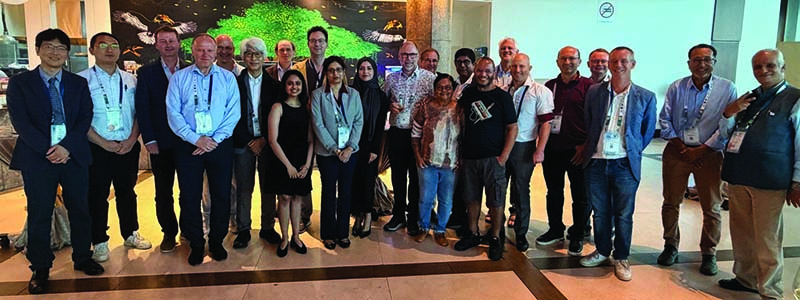
Attendees at the SCI-IUPAC networking reception
Throughout the week, we spoke with researchers at different career stages and from a wide range of countries and scientific backgrounds to help build new relationships across the wider international polymer community.
The conversations in Kuching also created opportunities to connect the research presented at the congress with future publication. A collection of selected papers from IUPAC MACRO 2026 is planned for Polymer International, providing a route for researchers to develop work shared at the congress into full journal articles. We are also exploring prospective collaborations with other polymer communities and conferences.
These activities support the wider purpose of the congress and its sustainability theme. Turning new scientific ideas into practical materials and technologies depends on research being shared, challenged and made visible to the people who can build upon or apply it. Journals have an important role in supporting that process by bringing together robust research from different countries, disciplines and career stages.
The success of SCI’s presence in Malaysia was very much a team effort. Professor Roger Hiorns, Executive Editor of the journal and a member of the IUPAC Polymer Division Committee, played a central role in making introductions, supporting commissioning and strengthening relationships across the polymer community. Our thanks also goes to Professor Igor Lacík, President of the IUPAC Polymer Division, who also provided valuable support throughout the congress.
More widely, the contribution of the Polymer International editorial board, SCI colleagues, the IUPAC Polymer Division and the local conference organisers made the week and the opportunities emerging from it possible.
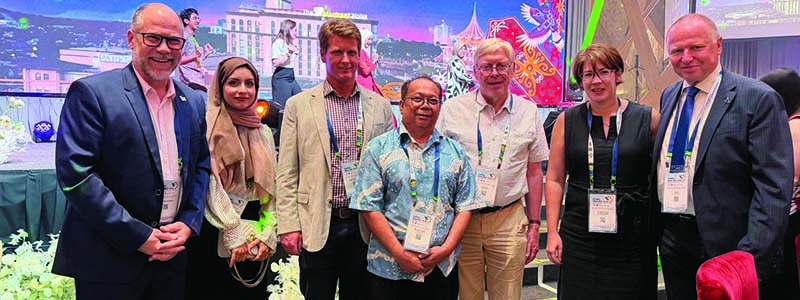
Polymer International board members and members of the IUPAC polymer division
We are now looking ahead to IUPAC MACRO 2028 in Strasbourg, France, where we hope to build an even stronger SCI and Polymer International presence. Our experience in Malaysia showed that being part of the international research community is about listening to researchers, learning about the ideas shaping their fields and creating opportunities for promising work to reach a wider audience.
As a not-for-profit learned society, SCI is proud to take its journals out into the world, meet the researchers driving their fields forward and support the communication of high-quality science.
Polymer International is particularly interested in research that reflects its focus on interdisciplinary innovation with industrial impact – work that advances polymer science while demonstrating its potential relevance and application beyond the laboratory.
If you have research that would be a good fit for the journal, or would like to discuss a potential review, research paper or conference collaboration, we would like to hear from you. Contact me at publications@soci.org, we are always happy to start a conversation about your work and how we can help bring it to a wider audience.
Find out more about Polymer International
 Visit Blog