Danish hydrogen production company Everfuel and Danish liquid fuel company Crossbridge Energy Fredericia have inaugurated their collaboration project, the HySynergy plant in Fredericia, Denmark, one of Europe’s first large-scale electrolysis plants to produce certified green hydrogen. Green hydrogen produced from renewable energy and is viewed as a key technology for the transition of heavy industry and transport in Europe.
US Secretary of Energy Chris Wright has announced the Department of Energy’s Loan Programs Office has closed a loan to support independent, US-made, coal-powered fertiliser production. The $1.5bn loan to Wabash Valley Resources will help finance a coal and ammonia fertiliser facility in West Terre Haute, Indiana, US. The project will restart and repurpose a coal gasification plant idled since 2016 to produce 500,000t of anhydrous ammonia/year by using coal from a nearby Southern Indiana mine and petcoke (petroleum coke) as feedstock.
US biotech Manifold Bio, a platform therapeutics company using AI-guided drug discovery coupled with direct-to-vivo measurement, has signed a strategic research collaboration and license agreement with Swiss pharma Roche. The partnership will apply Manifold’s proprietary tissue-targeting shuttle portfolio and mDesign AI-driven in vivo discovery engine to create multiple next-generation BBB (blood-brain barrier) shuttles for the treatment of neurological and neurodegenerative diseases.
Azalea Therapeutics, a US biotech developing precision genomic medicines in vivo, has announced its official launch and the completion of $82m in seed and Series A financing to advance its proprietary Enveloped Delivery Vehicle technology. The company’s aim is to engineer therapeutic cells with precision directly inside the patient, transforming how cell and gene therapies are created and delivered. The technology selectively targets cells, delivering transient CRISPR-Cas9 cargo to mediate programmable genome editing.
Swiss pharma Novartis has announced plans to expand its operations in North Carolina, US, creating a new flagship manufacturing hub with end-to-end manufacturing capabilities. The strategic investment is a major step towards ensuring all key Novartis medicines for US patients are manufactured in the US and delivered to patients across the country at scale. It is part of Novartis’ $23bn investment in US-based infrastructure over the next five years, which will include building a new site in Durham with the construction of facilities dedicated to manufacturing biologics and sterile packaging; and a new site in Morrisville to produce solid dosage tablets and capsules, including packaging.
Novartis has agreed a $12bn purchase of US biotech Avidity Biosciences, which is focused on a new class of therapeutics enabling RNA delivery to muscles.
US pharma Eli Lilly has announced plans to build a $3bn manufacturing facility in Katwijk, the Netherlands, located within the Leiden Bio Science Park. This project will expand Lilly’s capacity to produce oral medicines and strengthen the company’s global supply chain. The facility will incorporate advanced manufacturing technologies to meet the needs of Lilly’s growing portfolio of oral solid medicines in cardiometabolic health, neuroscience, oncology and immunology. Innovative capabilities will include dock-to-dock automation and material flow, paperless manufacturing, process analytical technology and spray-dried dispersion, which allows oral medicines to be effectively absorbed.
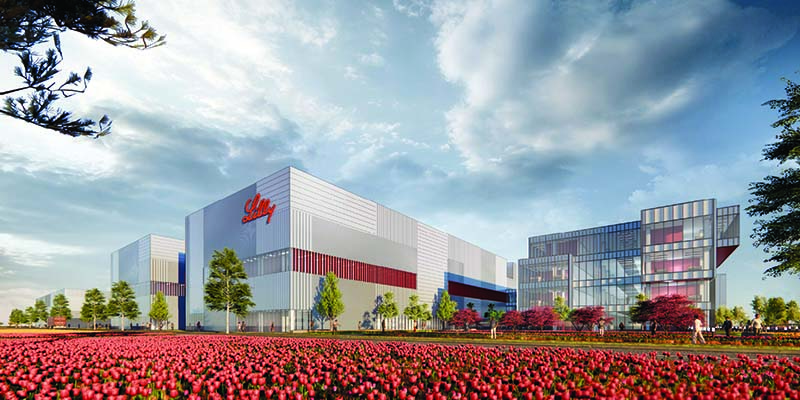
Eli Lilly’s proposed oral medicines manufacturing plant in the Netherlands
Swiss generic and biosimilar medicines manufacturer Sandoz has agreed with German drug discovery and development company Evotec to acquire all issued and outstanding equity interests of Just-Evotec Biologics, an Evotec subsidiary CDMO offering development and cGMP manufacturing services for antibody, next-generation biologics and biosimilar products. The acquisition aligns with Sandoz’s strategic objective of capitalising on a projected $300bn biosimilar market over the next 10 years.
German biotech QIAGEN is acquiring US biotech Parse Biosciences, a provider of scalable, instrument-free solutions for single-cell research. The acquisition will significantly expand QIAGEN’s Sample technologies portfolio into the fast-growing single-cell sequencing market with highly scalable chemistry designed for research involving up to millions and billions of cells.
NEOK Bio, a US biotech focused on the development of novel antibody drug conjugates (ADCs) for improving outcomes for cancer patients, has announced $75m in Series A financing. The company’s principal investor is ABL Bio, a Korean biotech and developer of antibody engineering. The funding will be used to advance two bispecific ADC programs into the clinic.
$1trn
US pharma Eli Lilly has achieved a valuation of $1trn, the first publicly traded healthcare company to reach this figure. Lilly’s stock value has risen in part because of its success with weight-loss medicines known as GLP-1s.
150,000 t
Norwegian advanced battery materials company Vianode will build its first large-scale production facility for low-emission synthetic anode graphite in Ontario, Canada. Synthetic graphite is an essential component in lithium-ion batteries, critical for a range of defence and industrial applications. The project is structured as a phased, multibilliondollar programme, starting with an initial investment of more than CA$2bn. Planned expansions will bring capacity up to 150,000t annually.
80%
Dutch manufacturer Blue Circle Olefins has selected Rotterdam to develop a commercial methanol-to-olefins production plant. The electrified 200,000t capacity plant will convert renewable methanol into 100% circular ethylene and propylene, the basic building blocks for about 60% of all products manufactured by the chemical industry in Europe. When the facility becomes operational in 2030, it will reduce life-cycle greenhouse gas emissions from plastics (PP, PE and PVC) by more than 80%, compared with current fossil-based production processes.
6000
Swedish food packaging and processing company Tetra Pak has opened a Product Development Centre for Powder Process and Technology in Cholet, France. The facility features a fully-equipped pilot plant with modular production lines and powder-handling technologies. From raw material characterisation and formulation through to pilot-scale simulation and industrial scale-up, it supports manufacturers from prototype to shelf. It has a library of more than 6,000 powder samples and specialist testing instruments.
German chemical major BASF has successfully begun production of the first products from the core of the Verbund at its Zhanjiang Verbund site in South China, marking a significant milestone in the company’s largest single investment project to date (€8.7bn). A BASF Verbund is a large system of physically, technologically and logistically integrated production plants that create efficient and resource-saving value chains. BASF’s largest and best-known Verbund is based in Ludwigshafen, Germany.
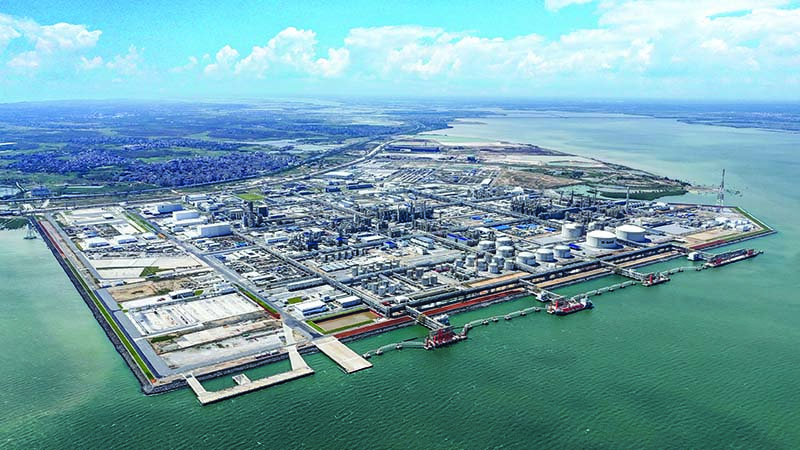
BASF’s Zhanjiang Verbund
US pharma, biotech and medical technologies corporation Johnson & Johnson has entered into a definitive agreement to acquire Halda Therapeutics OpCo, a US clinical-stage biotech with a proprietary Regulated Induced Proximity TArgeting Chimera (RIPTAC) platform to develop oral, targeted therapies for multiple types of solid tumours, including prostate cancer, for $3.05bn in cash.
Korean chemical and advanced materials company LG Chem and German optics and photonics company Zeiss have formed a strategic alliance to supply innovative photopolymer film on an industrial scale. These photopolymer films are a key material for Holographic Windshield Displays (HWD) in automotive applications.
German pharma and biotech Bayer has opened its E-Town Open Innovation Center in Beijing, China. The Center aims to foster deep integration among industry, academia, research and entrepreneurship, creating an open ecosystem that connects China’s innovation with the globe. The Center will incubate local innovative biopharma companies, help bring China-developed drugs to global markets, and strengthen China’s full innovation value chain. By partnering with academic and clinical research institutions, the Center will also enhance basic research and clinical translation capabilities while driving data-enabled digital business innovation.
South Korean life science infrastructure company Boryung has held a groundbreaking ceremony for the expansion of its penicillin production facilities at the Boryung Ansan Campus in Ansan, Gyeonggi Province. On completion, the facility’s total floor area will increase by more than 50%, and annual production capacity will more than double.
French biopharma Ipsen and French biotech ImCheck Therapeutics have entered into a definitive share purchase agreement in which Ipsen will acquire all issued and outstanding shares of ImCheck Therapeutics, a private company developing next-generation immuno-oncology therapies, for a total potential value of up to €1bn. The acquisition is focused on the lead Phase I/II program ICT01 in first line acute myeloid leukaemia patients who are ineligible for intensive chemotherapy.
Repare Therapeutics, a US clinical-stage precision oncology company, has entered into an agreement with Xeno Therapeutics and Xeno Acquisition, a US non-profit biotech research foundation, under which Xeno will acquire all the issued and outstanding common shares of Repare for around $78m.
US biotech Regeneron Pharmaceuticals has announced that it will create 1,000 new jobs as part of a $2bn investment at its new facility in Saratoga Springs in New York state. The company is converting a 93,000m2 former printing facility into a new biopharmaceutical production plant.
Thermo Fisher Scientific, a US supplier of analytical instruments, and laboratory, pharmaceutical and biotechnology services, has agreed to acquire Clario Holdings, a US provider of endpoint data solutions in clinical trials, for $8.875bn in cash.
Swiss specialty chemical company Clariant has entered a strategic joint venture with Chinese chemical company Shaanxi Fuhua Chemical to develop non-halogenated flame retardants. The initiative aims to create next-generation phosphorus-based flame retardants to serve several industries like building and construction, automotive, electrical and electronics, directly addressing the tightening technical and regulatory environment in these sectors.
German science and technology company Merck has inaugurated its Semiconductor Solutions megasite in Kaohsiung, Taiwan, after investing €500m. The new integrated production site focuses on semiconductor materials, especially thin films – the business within the Electronics business sector of Merck that recorded record sales in the Q3 2025, driven by surging demand for AI applications. Thin film technology allows materials to be deposited and removed on an atomic level, enabling more layers, higher complexity and the new chip architectures essential for advanced semiconductors.
Dulux coatings owner AkzoNobel agreed to merge with US paint and chemicals company Axalta to create a business with an enterprise value of $25bn, reviving a deal that had been mooted nearly a decade ago. The companies said the merger would unite ‘complementary portfolios of highly regarded brands’. The combined group will have a single listing in New York but maintain dual headquarters in Amsterdam and Philadelphia. It will have revenues of about $17bn, making it one of the largest operators in the coatings market. The merger is expected to generate savings of about $600m within three years. AkzoNobel CEO Greg Poux-Guillaume will lead the combined company, while Axalta’s Chris Villavarayan will be his deputy.
UK biotech Touchlight, a developer of cell-free DNA technology, has expanded its mbDNA platform with the introduction of three new circular DNA architectures: sscDNA, hsscDNA, and dscDNA. These innovative constructs join mbDNA, which debuted earlier in 2025, to form a comprehensive portfolio designed to overcome the limitations of traditional gene editing tools. The mbDNA platform and new custom circle DNA architectures deliver enhanced stability, reduced immunogenicity, and compatibility with a broad range of gene insertion and expression technologies for genetic engineering.
Belgian-French chemical major Solvay and US magnet technology company Noveon Magnetics have signed a supply agreement for light and heavy rare earth materials, which will help establish a sustainable supply chain for rare earth permanent magnets. Under the agreement, Solvay will supply neodymium-praseodymium (NdPr), dysprosium (Dy) and terbium (Tb) oxides to Noveon. These oxides will be extracted, among other sources, from end-of-life materials and advance Noveon’s production of finished rare earth magnets for key customers. Solvay will start supply to Noveon in 2026.
UK flow chemistry equipment manufacturer Vapourtec has installed its first Peptide-Builder system at the University of East Anglia in Norwich, UK. Peptides play a crucial role in modern drug discovery, biotechnology and materials science. However, traditional batch-based solid phase peptide synthesis methods can be time-consuming, prone to inconsistencies and often lack comprehensive data tracking. Peptide-Builder uses flow chemistry to enable rapid, high-purity, high-yield peptide production with full automation and open-access functionality, making it ideal for academic and industrial research environments.
Dermatology specialist Galderma continues to expand its US operations, as reflected in the opening of its new headquarters in Miami, FL, in June 2025, ongoing investments in its operational footprint and corporate and R&D hubs across three US states, as well as in healthcare professional education and training activities. Galderma has committed to spend more than $650m on US manufacturing through 2030. This includes ramping up final assembly and packaging for Nemluvio in Florida by its contract manufacturing partner, as well as the manufacturing of Alastin and select Cetaphil products via contract manufacturing partners.
 Visit Blog