BY MARIA BURKE
In late 2024, geothermal energy from the Earth was projected to supply as much as 15% of global electricity demand between now and 2050, according to the International Energy Agency[1]. Only two years earlier, geothermal’s share had been expected to remain at 1% for the foreseeable future. Maria Burke asks what has changed.
Geothermal energy derives from heat generated and stored within the Earth; temperatures rise with depth. This heat stems from Earth’s formation; friction as denser material sinks; and decay of radioactive elements. In regions where tectonic plates are separating, or the Earth’s outer layer is thinning, naturally circulating groundwater carries heat near the Earth’s surface – and in some cases above (geysers) – making energy extraction relatively simple. However, even where hotter temperatures are closer to the surface, like the southwestern US, reaching the high temperatures required for generating electricity can mean drilling to more than 4km in crystalline rock. Drilling and extraction costs increase with depth, affecting economic viability.
‘[Geothermal] has huge potential,’ says Eva Schill of Lawrence Berkeley National Laboratory, US. ‘We have all the Earth’s subsurface which we can access – typically, down to 5km.’ In future, researchers say this could be up to 10km. What’s more, the Earth’s heat is constantly available so energy can be harvested when needed.
‘To an extent, geothermal power plants can respond to changing electricity demand by increasing or lowering energy generation,’ Schill says. ‘We can even store large capacities of excess energy, for example, in depleted underground reservoirs once used for oil and gas extraction, to save or use at a time of particularly high energy demand.’
It’s also the least land-use intensive of all renewables and, if managed correctly, processes can be sustainable as fluid extraction is balanced with re-injection. On the downside, there are concerns over potential environmental side-effects as drilling can release gas and has occasionally resulted in local earth tremors.
‘Stimulating geothermal reservoirs, fracturing subsurface rocks to allow fluid flow and injecting fluids underground, cause movements or vibrations in the subsurface, most of which go undetected by humans.’ Schill says.
The IEA estimates that the Earth contains enough geothermal energy to meet global electricity demand (GED) more than 100 times over. Technological advances, an influx of private capital, and shifting energy and environmental policies are all driving renewed interest just as global energy demand surges. An added attraction is that lithium can be extracted from geothermal fluids. The IEA says geothermal projects under development in the EU and US could yield 47kt/year of lithium by 2035, meeting 5% of global demand.
Meanwhile, IEA analysis in 2026 found financing for next-generation geothermal reached nearly $2.2bn in 2025, up from $22m in 2018[2]. Mature conventional geothermal attracted nearly $5bn – four times more than 2018 – while geothermal heating projects, such as ground-source heat pumps, secured over $11.5bn in 2025.
By the end of 2025, ten countries accounted for more than 93% of installed geothermal power capacity: the US, Indonesia, Philippines, Türkiye, New Zealand, Kenya, Mexico, Italy, Iceland and Japan.
Next-gen geo
It used to be that geography – how close heat was to the surface – limited access to geothermal energy. But this is no longer the case, says a report from the Center for Climate and Energy Solutions[3]. Transfers of critical technologies, initially developed for shale gas extraction, are leading to ‘a momentous shift’ in the potential of next-generation systems. New projects are rapidly cutting drilling times and costs, and demonstrating the benefits next-generation geothermal can provide.
‘Fifteen years ago, experts on geothermal energy were convinced it would only ever be a niche solution,’ says Emily Pope, the report’s author. ‘Fast forward to today and we’ve made leaps and bounds in the technology, leveraging what we’ve learned from the oil and gas industry to offer a climate-friendly alternative that could solve some of our most difficult challenges in emissions reductions and grid reliability.’
Conventional geothermal systems use wells to tap into naturally circulating fluids at temperatures of 150-300°C. Fluids brought to the surface as steam, or liquids hot enough to convert to steam, drive turbines that generate electricity. Cooler or highly saline fluids below their boiling point are passed through a heat-exchanger first. Fluids may be injected back into the subsurface to extend the field’s lifetime.
But achieving large-scale electricity generation depends on a significant expansion of technologies that can take advantage of regions that have hot rocks but not necessarily the permeability or circulating hydrothermal fluids required for conventional geothermal power.
One of these new techniques is enhanced geothermal systems (EGS), which creates permeability in hot rocks by hydraulic fracturing. Other methods include using corrosive fluids to dissolve minerals filling natural fractures. After fracturing, cold water injected into the reservoir migrates through the fractures, absorbing heat from the surrounding rock before being pumped through a well for use at a power plant. Hydraulic fracturing combined with microseismic imaging makes it possible to control the direction and scale of induced fracturing, while horizontal drilling enables more precise targeting of aquifers. Both techniques were initially developed for shale gas extraction.
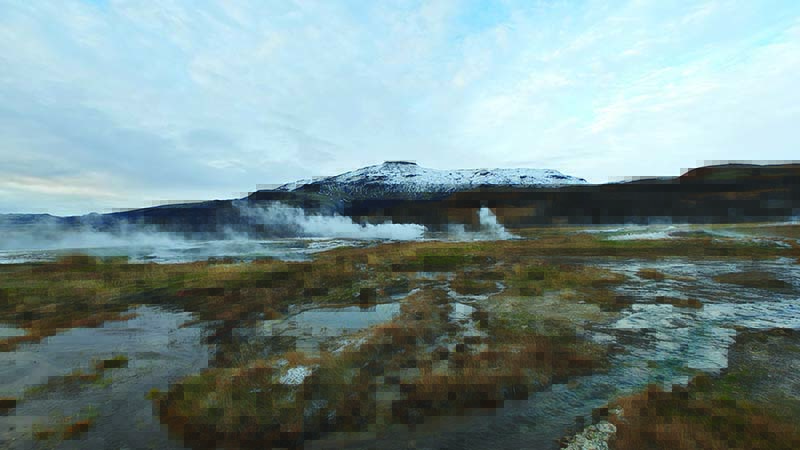
Around 20 EGS plants operate in Europe, providing heat and/or electricity, according to a Stanford University review[4]. Most operate for research purposes or produce modest amounts of energy: a few megawatts electrical or a few tens of megawatts thermal.
Historically, technical issues over induced seismicity have hindered expansion. But the IEA says this is changing, pointing to examples such as Germany’s new Geothermal Energy Acceleration Act and the EU’s forthcoming Geothermal Action Plan.
In the US, several large-scale projects are under development. Schill notes that EGS in the US moved beyond demonstration plants in 2025[5]. ‘Horizontal multistage EGS are demonstrating reproducible high flow rates and stable thermal output, highlighting progress towards larger scale commercial EGS facilities.’ She highlights a first-of-its-kind EGS in Oregon that accessed dry rock at record temperatures of 330°C[6].
The Stanford review says adaptation of oilfield drilling strategies has shortened EGS drilling times by 50–70%. With further development to manage induced seismicity risk and increase system flexibility, much larger EGS projects – hundreds of MW of electricity – will be able to produce electricity at market-competitive prices. In the US, this should happen by 2027. One company applying drilling technology from the oil and gas industry to developing EGS is Houston-based Fervo Energy. It has invested more than $2bn in a plant in Utah, expected to come online later in 2026. Test results announced in February 2026 from a vertical appraisal well confirmed resource temperatures above 291°C at around 3.4km deep. Fervo says this exceeds requirements for commercial viability and confirms a multi-gigawatt resource potential. The target reservoir comprises sedimentary rocks that are easier to drill than the more commonly targeted granite formations (granite retains heat well).
Fervo, which launched on Nasdaq in May 2026 generating $1.89bn, is one of several US geothermal companies benefiting from the US Government’s decision to continue federal investment tax credits for commercial geothermal projects until the mid-2030s; they will expire for all other renewable energies at the end of 2026. Geothermal companies are also well-placed to respond to surging electricity demand from tech companies, which appear willing to pay a premium for clean, dependable power to power resource-intensive data centres. Google’s owner Alphabet has invested in Fervo.
Other technologies
Apart from EGS, horizontal drilling also provides a pathway for another novel technology: closed loop geothermal. A ‘working fluid’ is circulated through a closed loop of underground pipes and absorbs heat from the surrounding hot rock before returning to the surface. The fluids – such as brine, carbon dioxide, or refrigerants – can be continuously recycled.
This technique avoids extracting water from the ground and doesn’t require expensive drilling techniques to target fractures in rock. Closed-loop projects are being pioneered in countries like Germany and Canada, by companies such as Eavor, which uses a proprietary fluid in its system. At its plant in Bavaria, the company’s system reaches depths of 4.5km. It generates power (8.2MW) and heat (64MW) for the local district.
Meanwhile, supercritical geothermal is developing traditional or next-generation systems at temperatures and pressures above the supercritical point of water (ca 374°C.) These fluids have significantly higher energy density than non-supercritical fluids, so offer potentially higher returns on energy.
Several breakthroughs in drilling technology and techniques have also made geothermal more economically viable. These include new polycrystalline diamond compact drill bits, which can increase drilling rates by up to 70%. Other projects are developing their own proprietary drilling technologies, such as the EU’s DeepU, which is testing lasers combined with cryogenic gas to liquify and vitrify rock, enabling faster drilling speeds. US company, Quaise, a spin-out from Massachusetts Institute of Technology, is developing a technology from nuclear fusion research to vaporise rock using millimetre-wave radiation. Quaise says it could be several times faster than conventional drilling and enable drilling up to 20km where rock temperatures reach 500°C, unlocking terawatts of energy.
Cornwall’s geo promise
The UK’s first geothermal plant to generate electricity started operating in February 2026 in Redruth, Cornwall. Geothermal Engineering (GEL) drilled the country’s deepest and hottest well. Reaching over 5km, it accesses fluids circulating through fractures in granite at above 190°C. The plant uses this hot brine to vaporise a secondary working fluid that drives the turbine to generate electricity for 10,000 homes. GEL is developing two further sites in Cornwall, expected to add 10MW of baseload power by 2030. The plant will also provide the UK’s first domestic supply of lithium and is the largest commercial-scale lithium carbonate production facility in Europe. Initially producing 100t/year, this could eventually reach 18,000t/year.
The UK has many geothermal heat projects, but this plant proves higher temperature geothermal power projects are achievable in the UK, says Alison Monaghan of the British Geological Survey. For example, Eden Geothermal, a spin-out from the Eden Project, has been operating a geothermal plant since 2023 to generate heat for the biomes. It hopes to provide electricity in future.
‘Historically, cost has been the main deterrent [to geothermal], though this is changing as technology and the financing environment mature,’ says GEL’s CEO Ryan Law. ‘While this first UK project is relatively expensive, the economics improve considerably at scale.’
The plant received £50m from private investors and the EU; the government contributed around £172m, thought to be half the cost of the initial lithium extraction facility.
‘Co-producing lithium also strengthens project economics, since extraction uses the same wells and fluids,’ he continues.
‘As more projects reach commercial operation, investor sentiment is shifting, leaving policy as the bigger constraint. Permitting is now the most pressing issue for the sector. The main constraints are planning and grid connection rather than technology.’
A report on geothermal in the UK in February 2026 from not-for-profit Project InnerSpace notes multiple agencies and regimes are responsible for permitting and oversight, increasing costs and slowing projects[7]. It calls for a dedicated national geothermal strategy, a ‘one‑stop’ desk to coordinate permits, and standardised reporting and data‑sharing.
Meanwhile, trade association Geothermal UK wants government to recognise geothermal in its energy strategy. The UK needs to catch up, it says; European countries such as France, Germany, Italy and the Netherlands are already experiencing the benefit of geothermal resources at scale.
‘Other western European countries with similar geology have targets that geothermal energy will supply 25-40% of heating and cooling by 2050,’ agrees Monaghan.
‘In the UK, we’ve a well-developed ground-source heat sector … and a growing number of deep geothermal projects planned to supply large sites – eg universities, hospitals – or feed into heat networks.’
‘The UK stands at a historic energy crossroads,’ says Drew Nelson of Project InnerSpace.
‘The opportunity is vast, and it’s one we can seize now using the skills and technologies the UK already has.’
References
- The Future of Geothermal Energy, IEA, December 2024
- Investment in next-generation geothermal is surging, IEA, January 2026
- Drilling Down: What it Will Take to Harness the Potential of Next-Generation Geothermal, Center for Climate and Solutions, April 2026
- R Horne et al, Nat. Rev. Clean Technol. 2025; doi: 10.1038/s44359-024-00019-9
- E Schill et al, Nat. Rev. Clean Technol. 2026; doi: 10.1038/s44359-025-00143-0
- G. Grubac et al, Paper presented at the SPE Annual Technical Conference and Exhibition, Houston, Texas, USA, October 2025; DOI: 10.2118/228078-MS
- The future of geothermal in the UK, Project InnerSpace, February 2026
 Visit Blog