
Sustainability & Environment
Johnson Matthey has launched a technology to help create a green hydrogen-based aviation fuel, while the European Commission has approved a €900 million scheme (£750 million approximately) to support renewable hydrogen investments.
SCI Corporate Partner Johnson Matthey has developed HyCOgen to convert CO2 and green hydrogen into a scalable and sustainable aviation fuel (SAF). The speciality chemicals company says it has combined this Reverse Water Gas Shift technology with FT CANS Fischer Tropsch technology through a catalysed process. With this approach, the green hydrogen and CO2 are converted into carbon monoxide, which is combined with additional hydrogen to form syngas.
Integration with the FT CANS technology is used to turn 95% of the CO2 into a high quality synthetic crude oil. This synthetic crude oil can then be upgraded into sustainable, drop-in fuel products for aviation transport – a sector responsible for 12% of transport-related CO2 emissions, according to the Air Transport Action Group.

Green hydrogen fuel, produced using renewable energy, could help decarbonise the aviation industry.
Jane Toogood, Sector Chief Executive at Johnson Matthey, said: “Given the challenges associated with new propulsion technologies and airport infrastructure, plus the long asset life of aircraft, there are significant hurdles in moving from hydrocarbon-based aviation fuel to alternatives such as battery electric or hydrogen.
“By combining HyCOgen with FT CANS, we can now deliver customers a cost-efficient, reliable and scalable technology to help increase SAF production, backed by our track record of successful technology development and commercialisation.”
>> Concerned about climate change? Find out what you can do in this free webinar: https://www.soci.org/events/hq-events/2022/why-we-ignore-climate-change-and-what-we-can-do-about-it
€900 million fund for non-EU countries
In other hydrogen-related news, the global hydrogen industry has received a boost with the European Commission approving a €900 million German scheme to support investments in renewable hydrogen production in non-EU countries.
The aim of the H2Global project is to meet the growing EU demand for renewable hydrogen production, which is expected to increase significantly as EU countries reduce their reliance on fossil fuels. Even though the initiative will benefit EU countries, UK-based organisations concerned with hydrogen power could benefit from this investment.
>> Young chemists are getting creative in the fight against climate change. Read more in our COP26 review blog.
Margrethe Vestager, the European Commissioner for Competition who is in charge of competition policy, said: “This €900 million German scheme will support projects leading to substantial reductions in greenhouse emissions, in line with the EU’s environmental and climate objectives set out in the Green Deal.
“It will contribute to addressing the increasing demand for renewable hydrogen in the Union, by supporting the development of this important energy source in areas of the world where it is currently not exploited with a view to importing it and selling it in the EU. The design of the scheme will enable only the most cost effective projects to be supported, reducing costs for taxpayers and minimising possible distortions of competition.”
11 January 2022 |
|


 |
|

Careers
Our careers often take us in unforeseen directions. Dr Jessica Jones, Applications Team Leader at Croda, chatted to us about moving from research into management, the benefit of developing softer skills, and her unexpected mentor.
Tell me about your career to date.
I came through university in what is probably seen as the ‘traditional’ way. I did a Master’s degree in chemistry at the University of Liverpool, with a year working in industry, which I really enjoyed. And then after I finished my Master’s, I did a PhD in Inorganic Chemistry at the University of Nottingham. I always wanted to work in industry, but I really enjoyed research, so I decided to do the PhD as I thought the skills would be useful for either career path.
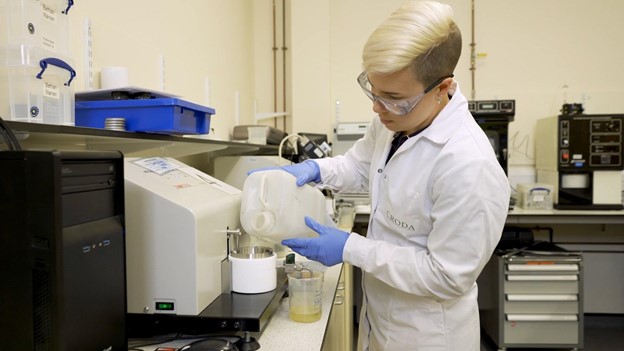
Jessica Jones in the lab
Were you tempted by a career in academia?
No, I never felt like I was the kind of person who had what it takes to succeed in academia. I never felt like I could ever come up with the nucleus of a new idea. I always felt like someone could give me the slimmest thread of a thought and I could turn it into something, but I could never have that thread myself. From my perspective, academia can be a lonely career and I enjoy and benefit from working in a team with other people.
So, after I finished my PhD, I joined Croda in 2013 as a Research Scientist in our synthesis division, in a synthetic chemistry R&D role. Over seven years, I progressed from Research Scientist to Lead Research Scientist and then Team Leader. During that time, I moved around a bit. I worked at different manufacturing sites, in different research areas and did lots of different projects across multiple sectors.
In February 2020, I was asked if I wanted to go on secondment, as a Team Leader, to one of our applications teams in Energy Technologies. Energy Technologies focuses on lubricants, oil and gas, and batteries. I really enjoyed the secondment and after it came to an end, I chose to take it on as a permanent position rather than return to my old role.
What does this role entail?
My role entails managing a team of application and lead application scientists who work on a range of projects, from designing new products to supporting customers with specific problems and working with universities on more theoretical, developmental ideas.
At the moment, we’re working on a lot of what we call EV (electric vehicle)-friendly fluids. When you move from traditional combustion engines to electric vehicles, there’s quite a change in the properties needed for the fluids within the engine. We make the speciality additives that go into the base oils that support functions such as reduced engine wear and improved fuel efficiency.
The EV market is very different to the traditional car market, which is dominated by big lubricant manufacturers. EVs are so new that Croda has been at conception discussions with world leading EV companies. The whole sector is very data driven and, coming from a research scientist background, that appeals to me very much. It’s very exciting to be at the cutting-edge of innovation with what we’re doing within electrification and renewable energy.
Which projects are you working on at the moment?
I’ve got two long-term new development projects that are both progressing to the final stages of manufacturing. These are products that I designed the chemistry for when working in the synthesis team. It can take four or five years to get a new project through the development process, and I’ve continued to manage them throughout their timeline, even though I have moved into different roles. They are both speciality additives for crude oil to reduce the temperature at which impurities develop, to allow the more difficult oil fractions to be brought out of the ground without it solidifying in pipes when they transport it.

What does a general working day involve?
There are eight people in our team, and I am responsible for managing six of them. There are two other senior technical specialists I work alongside. They have lots of experience in the industry and working with academia, and the three of us coordinate the projects across the team.
My role is to translate the pipeline and the strategy from our senior leaders into what we do in the lab every day. I have three projects that I'm running, which are new product launches. Alongside that, I coordinate the project pipeline and make sure everyone is able to manage their projects and progress them. I do a small amount of lab work, but I would say it makes up 5% of my time.
I always thought I would be a specialist when I joined Croda because of my PhD and lab experience. However, over the time I’ve worked here, I started to really enjoy working with other people; and I think I probably realised I had better skills at motivating other people, building up teams, and networking. So that became a lot more important, and I chose to move into the management side of things but still within a technical function.
Interpersonal skills are sometimes underrated in management. How do you approach this side of the job?
I think I am quite at ease around other people as I am very extroverted. I think that makes me different from a lot of people in my team. For example, my boss and I are the total opposite of each other, but it works really well because it means that we complement each other perfectly. He’s very strategic and he likes to take his time to make decisions. He likes to review all the data very methodically and is good at using detail to evaluate a project’s true value, whereas I’m much more about talking to people, bringing everyone together and acting quickly to get things done. But I think the balance of both works incredibly well for us as a team.
During lockdown we received a webinar on personal resilience, and the session was about your outward projection to other people. About 70% of how you are perceived by others is made up of how people see you and your ‘brand’. Your technical expertise and actual ability to do your job only makes up about 20% of how people view you and how successful you are. And I think as a scientist, you get a bit focused on delivering the project successfully, thinking that you need to be really amazing at delivering data, but people forget about the need to work on themselves to develop as well.
What part of your job motivates you most?
It’s a combination. The science we’re working on is very exciting, and I really enjoy getting all the projects together, making sure everything fits together and that everyone’s doing the right thing. But emotionally, it’s the team that gets me up in the morning – coming in, seeing what they do, how they have been. I’ve been really lucky over the past 12 months, being able to see some of my colleagues really develop. I’ve taken a lot of pride in realising the impact you can have on other people and allowing yourself to take credit for that.
>> What is life like as a materials scientist? Take a look at our thought-provoking conversation with Rhys Archer, founder of Women of Science.
Which mentors have helped you along the way?
There’s one person who stands out. I was asked to take on this extra role to become a European technical rep in one of our business areas. I’d never done anything like that before so the idea that I was going to be put out there, in front of customers, as the technical expert for the business was quite terrifying.
I was to work with the European Sales Manager of the business, and we ended up traveling a lot together. He was the opposite to me. He’s very experienced but had a reputation as a bit of a loud, burly Yorkshireman and I wasn’t sure how we would fit together, but we got on like an absolute house on fire. He was so helpful to me, not just in giving feedback on what I was doing in the role, but general conversations about career and life outside of work and personal support. Having that kind of professional relationship develop has made a massive difference. Just meeting someone like that and having a person to go to when I needed help, someone who I really trust to have my best interests at heart. It was very beneficial for the number of years that we worked together. Since then, we have moved on to different roles, but we still stay in touch, and it has taught me the value in reaching out to different people to help me to develop.
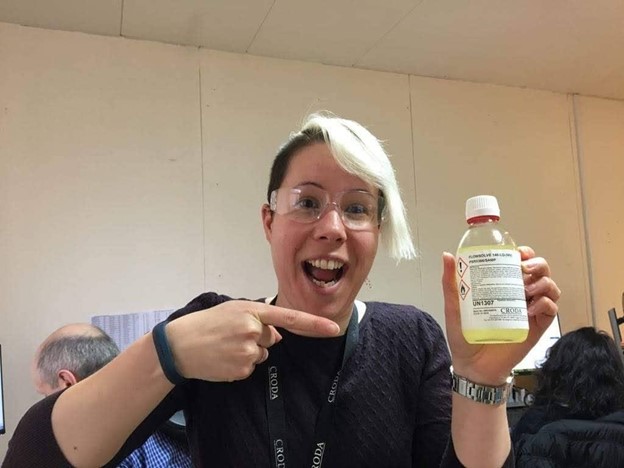
Jessica with the first product she developed at Croda.
In terms of equality and diversity, do you think enough is being done in your sector?
I think there is always more that can be done but I’ve never felt my gender has hindered me in my career and I’ve always felt very supported at Croda. Sometimes people are in a rush to see change immediately, especially when the senior management at Croda and many other STEM organisations is still made up of a majority of white males.
I like to think that the support myself and others have been given will mean that, as we progress, there will be more representation in senior positions. I would always want to achieve something on merit rather than to tick a box for equality. If that means it will take time for the generation I am in now to get to those positions, then I can wait. Importantly, I genuinely think everything that’s being put in place at Croda, and more broadly across the STEM sector, will pave the way for more diverse representation in senior roles in the future.
Do you have any advice you’d give to someone starting out?
Having a mentor is very important. I never thought I needed one until accidently developing that relationship. Since moving into different roles, I’ve set out to deliberately engage with people for that purpose. I would encourage people to seek out those who are different from themselves and engage with them.
I also think it’s important not to be afraid to ask for things you want. If you want to get a promotion or seek out further development, it’s often tempting to ask permission. If you can demonstrate to people that you are ready, it is more effective.
Generally, I think people, especially women, really underestimate the value of self-promotion as they worry it can be perceived as arrogance. A lot of people think that if you simply do a good job, then you’ll be recognised for that. That would be amazing if it were true, but people will judge you on how you’re perceived and how you present yourself, as well as what you do.
I think you need to put yourself out there. Whether it’s getting involved in something outside of your day job or taking the lead in a particular task, it’s a great way to get recognised. Sometimes it won’t work out and it can be hard to take the criticism when that happens, but you always learn from the outcome. I always prefer to have given something a go, even if I fail, than never to try.
Finally, I think people should always be themselves because everyone has unique skills to offer. I don’t think people would look at me and think that I look like the manager of a technical team, but I’m comfortable with my own style and that makes other people comfortable with it too.
>> We’re always interested in hearing about different people’s diverse career paths into chemistry. If you’d like to share yours, get in touch with us at: eoin.redahan@soci.org
08 November 2021 |
|
|
Sustainability & Environment
A group of inspiring young scientists took centre stage at COP26 on 4 November to show how the next generation of chemists is finding tangible climate change solutions.
In a day dominated by what countries pledged to stop doing at COP26, such as pursuing coal power and financing fossil fuel projects overseas, it was refreshing to learn about low-carbon technologies and the young people driving their development. At the Next Gen forum, we heard from an array of young chemists, all associated with SCI, who are at the sharp edge of this change.
We heard from Brett Parkinson, Senior Engineer of Low Carbon Fuels and Energy Technologist at C-Zero, who is working on commercialising a way to decarbonise natural gas. The California-based company’s technology converts the natural gas into hydrogen and solid carbon to provide a clean energy source while sequestering the carbon; and the aim is to have this process up and running next year.
Natasha Boulding is building towards Net Zero a different way – with a greener concrete. The CEO and Co-founder of Sphera has developed a lightweight carbon negative additive using waste plastics that aren’t currently being recycled. She says the company’s blocks are the same strength and price as existing concrete blocks, but with 30% more thermal insulation. There is also the added benefit of reusing waste materials that would otherwise have gone to landfill or been incinerated.
Another solution discussed by Dominic Smith, Process Development Engineer at GSK, reduces energy consumption through green chemistry. He is trying to find greener ways to make medicines using enzymes. These enzymes, which can be found in plants and soil, replace chemical synthesis steps to cut energy consumption during processing and reduce hazardous waste.

Panel (left to right): Dominic Smith, Natasha Boulding, Clare Rodseth, Jake Coole, Nikita Patel, and Oliver Ring (Brett Parkinson spoke via video link).
It was apparent from the discussion that many solutions will be needed for us to reach our climate change targets. On the one hand, Jake Coole, Senior Chemist in Johnson Matthey’s Fuel Cells team, is working on membrane electrode assembly for hydrogen fuel cells to help us transition to hydrogen-powered buses and trucks.
At the same time, Clare Rodseth, an Environmental Sustainability Scientist at Unilever, has been using lifecycle assessments to reduce the environmental impact of some of the 400 Unilever brands people use all over the world every day. For example, this work has helped the company move away from petrochemical ingredients in its home care products. ‘Even small changes,’ she said, ‘have the potential to bring about large-scale change.’
Incremental change
However, for each of the technologies discussed, barriers remain. For Coole and co., having a readily available supply of hydrogen and charging infrastructure will be key. And for Dominic Smith and his colleagues, the use of enzymes in green chemistry is still in its infancy; and getting enzymes that are fast enough, stable enough, and produce the right yield is difficult. Nevertheless, he noted that manufacturers are now using enzymes to produce the drug amoxicillin, reducing the carbon footprint by about 25%
And some things will take time to change. Natasha Boulding noted that concrete is the second most used material in the world after drinking water, and we simply can’t create many green technologies, such as wind turbines, without concrete foundations.
She said the construction industry is quite traditional but also pointed to perceptible change, with the green concrete market growing and companies becoming increasingly aware of their carbon footprints.

Collaboration was seen as crucial in producing climate change solutions.
The reality is that global action on climate change is recent. As Brett Parkinson said: ‘the main reason we’re talking about it now is that there’s a driver to do it. Until the last decade, the world hadn’t cared about CO2 emissions. They just talked about caring about it.’
How pivotal is science in all of this?
So, what could be done to make climate action more effective? For Parkinson, effective policy is key. He argued that if the market isn’t led by policies that encourage low-carbon innovations, then it won’t work as needed. ‘It all starts with effective decarbonisation policy,’ he said. ‘Legacy industries are very resistant to change. If you don’t have strong and consistent policies… then they’re not going to adapt.’
Another key to our low-carbon evolution is collaboration, and the SCI provides a confluence point for those in industry and academia to work together to produce innovative, low-carbon products. As Clare Rodseth said: ‘Collaboration is really important – linking up people who can actually come together and address these problems.’
As the discussion came to a close, you had the impression that the debate could have gone on for much longer. ‘Hopefully, we’ve demonstrated that there is action, and it’s being driven by young people like our panellists today,’ summarised Oliver Ring, the event’s co-Chair, before asking for the result of the audience poll.
The question: How many of those watching believed that science is pivotal in providing climate change solutions?
The answer: Just the 100%.
>> Thank you to Johnson Matthey for sponsoring the event, to the speakers for sharing their time and expertise, and to co-chairs Nikita Patel and Oliver Ring for doing such an excellent job.
05 November 2021 |
|
|
Careers
Marking Black History Month and following on from the #BlackInChem initiative, SCI is continuing its look back at some of the unsung Black scientists who pioneered, and made important contributions, to the advancement of science.
Today we profile Lewis Howard Latimer, much admired by his contemporaries; Alexander Graham Bell and Thomas Edison, but sadly a name, and story, that is not as well known.
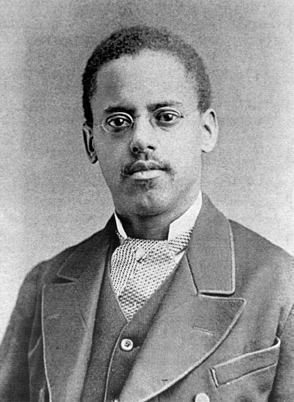
Lewis Howard Latimer | Image Credit: By Unknown author - http://www.lrc.rpi.edu/resources/news/pressReleases/img/Lewis.jpg, Public Domain, https://commons.wikimedia.org/w/index.php?curid=2032528
Lewis Howard Latimer, the youngest of four children, was born in Chelsea, Massachusetts, on 4 September 1848. His father, George Latimer, a slave who had escaped, became something of a cause celebre when his owner recaptured him. However, abolitionists took his case to the Supreme Court and his freedom was secured.
Lewis proved to be an excellent student, with a particular flair for drawing, as well as writing poetry and stories, but lack of finance and restricted access to education meant that by 15 years of age, Lewis had joined the US Navy. The history books indicate that he was honourably discharged in 1865; when the Civil War ended.
Soon after, Latimer found work as an office boy with the patent firm Crosby, Halstead and Gould. It is here that combining his talent for drawing, and developing the skills of a draughtsman he was eventually promoted to the position of head draftsman. The history books record that Latimer’s first patent, in 1874 with colleague Charles Brown, was an improved toilet system for railroad cars.
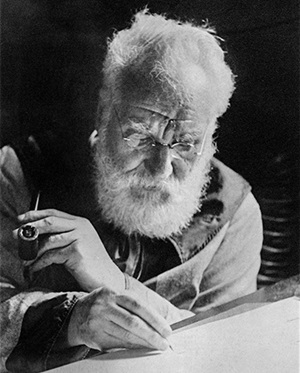
Lewis Latimer was instrumental in helping Alexander Graham Bell file his patent for the telephone ahead of his competitors.
Latimer had many inventions, but it could be argued that his drawings for Alexander Graham Bell’s telephone, helped seal his place in science history. The story goes that Bell was in a race against time, as rivals were also looking to gain patent rights for a similar device. Bell hired Latimer who used his expertise in drawing and submitting patent applications to help Bell file his patent just hours, it said, before his rival in 1876.
By 1880 Latimer had taken up the post of mechanical draughtsman for the inventor Hiram Maxim, who was also the founder of the US Electric Lighting Company. Now focused on incandescent lighting, Latimer along with Joseph Nichols, invented a light bulb which used a carbon filament, an improvement on Thomas Edison’s paper filament. The invention, patented in 1881, was sold to the US Electric Lighting Company in the same year.
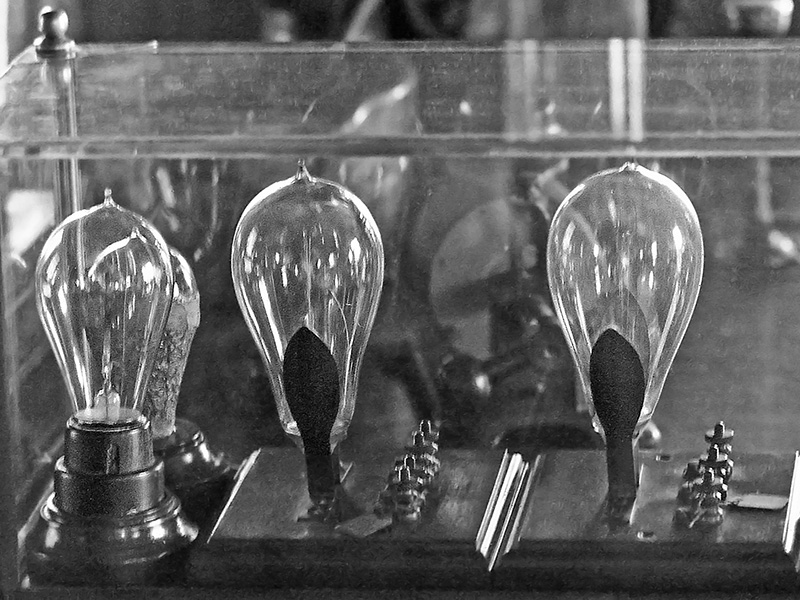
Latimer invented a process for making carbon filaments for light bulbs | Editorial credit: Claudio Zaccherini / Shutterstock.com
1A booklet by the Thomas Alva Edison Foundation noted; ‘Latimer invented and patented a process for making carbon filaments for light bulbs. He taught the process to company workers, and soon it was being used in factory production. Latimer also assisted in installing Maxim lighting systems in New York City, Philadelphia, Montreal and London. During the installation of lighting in Montreal, where a lot of people spoke only French, Latimer learned the language in order to competently instruct the workers. In London he set up the first factory for the Maxim-Weston Electric Light Company. That required him to teach the workmen all the processes for making Maxim lamps, including glass blowing. In just nine months Latimer had the factory in full production.’
In 1882 Latimer left Hiram Maxim and in 1884 joined the Edison Electric Light Company, where he was given the title draughtsman-engineer. In 1890 he joined the Edison Legal Department, and in 1893 testified in a case where the company said that its incandescent lamp patents had been infringed. In 1896 the Board of Patent Control of GE and Westinghouse was formed and Latimer became its Chief Draughtsman. He continued in that role until 1911 when he joined the consulting firm Edwin W Hammer.
On 24 January 1918, Latimer was named one of the 28 charter members – and the only African-American member – of the Edison Pioneers, ‘a distinguished group of people who worked to keep the ideals of Thomas Edison alive.’ The Edison Pioneers helped create the US’ electric power industry.
Latimer received patents for several inventions, including the safety elevator. He also had a passion for social justice. In a letter written in 1895 in support of the National Conference of Coloured Men, Latimer wrote: ‘I have faith to believe that the nation will respond to our plea for equality before the law, security under the law, and an opportunity, by and through maintenance of the law, to enjoy with our fellow citizens of all races and complexions the blessings guaranteed us under the constitution.’
Latimer died on 11 December 1928. Edison Pioneers historian and long time private secretary of Thomas Edison, William H. Meadowcroft wrote1 ‘Lewis Howard Latimer was of the coloured race, the only one in our organisation, and was one of those to respond to the initial call that led to the formation of the Edison Pioneers, January 24 1918. Broadmindedness, versatility in the accomplishment of things intellectual and cultural, a linguist, a devoted husband and father, all were characteristics of him, and his genial presence will be missed from our gatherings…We hardly mourn his inevitable going so much as we rejoice in pleasant memory at having being associated with him in a great work for all peoples under a great man.’
1For more information on Latimer’s life, work and legacy, see the Edison Electric Institute resource: Thomas Alva Edison Associate: Lewis Howard Latimer: A Black Inventor.
04 October 2021 |
|
|
Materials
A little talked about element, with the atomic mass 140, plays a surprisingly important role in everyday life. It has not only lit many a path, but can be credited with improving and saving the lives of billions of people by enabling cleaner air.
In his talk '140Ce: White light & Clean Air' Andy Walker, Johnson Matthey’s Technical Marketing Director explained why the soft, ductile silvery-white metal Cerium, deserves more recognition.
Walker began by outlining the history of SCI, celebrating its 140th anniversary this year. As an employee of Johnson Matthey, Walker highlighted that George Matthey was among the pioneers of SCI. In addition Walker explained that his PhD research had involved looking at catalysts that included Cerium.
Cerium is a lanthanide and the 26th most abundant element on earth. Indeed it was the first lanthanide to be discovered, found as its ore cerium silicate, in 1803. Cerium makes up 66ppm of the earth’s crust, which is about 5 times as much as lead. It is the only one of the lanthanides able to take on the +4 oxidation state, making it very useful in some of its applications. It is mined in the US, Brazil, India, Sri Lanka, Australian and China, with annual global production of 24 000 tonnes.
However, this straightforward look at the history of Cerium conceals a much more interesting narrative about how this element shaped the life of a number of prominent chemists of the day. Indeed Cerium was found as early as 1751 at a mine in Vestmanland, Sweden by Axel Cronstedt, who also discovered Nickel. Believing it to be an ore of Tungsten, he sent it to Carl Wilhelm Scheele for analysis. However, Scheele was not able to identify it as a new element.
This turn of events for Scheele, perhaps unfairly, helped to seal his moniker as the ‘unlucky chemist’. Scheele, a prominent chemist and pharmacist, had a number of discoveries to his name. He isolated lactic acid, and discovered hydrogen fluoride and hydrogen sulphide.
But as Walker explained, his most notable discovery was oxygen, some three years before Joseph Priestley. Sadly for Scheele; it took him six years to publish his findings, by which time Priestley had already presented his data. Putting a contemporary slant on Scheele’s misfortune, Walker added that the cautionary tale here was that getting things out into the public domain as soon as possible can be important to ensure credit goes to the right people.
Further work by Scheele led to the discovery of a number of elements including barium and chlorine, but sadly he did not receive any recognition because he didn’t manage to isolate them and identify them correctly. The chemist Sir Humphrey Davy did so, some years later, getting the credit for their discovery and isolation.
So it was in 1803 that chemists Wilhelm Hisinger and Jons Jacob Bezelius proved that Cerium was indeed a new element, naming it Cerium after an asteroid/dwarf planet which had been called Ceres. The successful isolation of Cerium took place in 1875, carried out by American chemists William Hillebrand and Thomas Norton, by passing an electric current through molten cerium chloride.
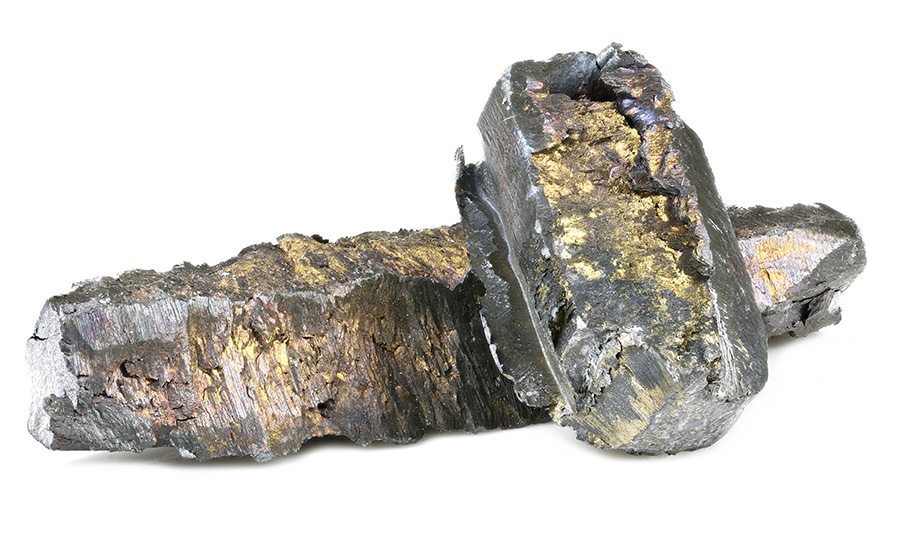
99.95% fine cerium isolated on white background
Once isolated, the earliest application of Cerium was in incandescent gas mantles. Developed by Carl Auer von Welsbach, in 1891, he perfected a mixture of 99% thorium oxide and 1% ceria, which gave a soft white light. Introducing his new mantle commercially in 1892, von Welsbach was able to monetise his development selling his product throughout Europe.
Gas mantles have been replaced, but Cerium’s importance in producing white light remains. As Walker explained, most white LEDs use a blue gallium nitride LED covered by a yellowish phosphor coating made of cerium-doped Yttrium Aluminium Garnet crystals.
In the medical arena, Cerium was used by Sir James Young Simpson, Professor of Medicine and Midwifery at Edinburgh who did a lot of work in the area of anaesthetics. Simpson found that cerium nitrate suppressed vomiting, particularly that associated with morning sickness, and well into the last century, medication containing Cerium could be bought over the counter. In addition Cerium has been the basis of treatments for burns.
Other applications for this versatile element are self cleaning ovens and mischmetal alloy, used in flints for cigarette lighters. Walker shared that the chemist and author Primo Levi, while imprisoned in Auschwitz, was able to steal cerium-iron rods from the laboratory he was forced to work in. Making them into cigarette lighter flints, he was able to barter for bread. Cerium is used to harden surfaces; it is a good polishing agent. Cerium sulphide has been used to replace the pigment cadmium red as a non-toxic alternative and Cerium is widely used across the chemical industry as a catalyst to produce a host of chemicals.
Catalysis is probably where Cerium has impacted most people as the element is the basis for the catalytic converters that have provided cleaner air for billions of people. Walker explained that the driver for the development came during the 1950s when photochemical smog was a problem in the Los Angeles Basin. Measurements at the time indicated that vehicles were responsible for the majority of the hydrocarbon and NOx emissions that led to the polluted air.
This turn of events led researchers to develop systems that could mitigate the emissions. Johnson Matthey was among those doing the early work on catalytic converters. Meanwhile, the automotive industry was pushing back on their introduction, concerned about the costs, durability and effectiveness. Working with Ricardo Engineering, Johnson Matthey carried out durability tests over 25 000 miles which also showed that the catalysts could pass US emissions tests.
The catalysts had to operate in three ways, at the same time, oxidising carbon monoxide (CO) and hydrocarbons (HC) while reducing NOx. Early catalysts, circa 1975, were based on Palladium and Platinum and focused on oxidising the CO and HC. Around 1978 a second catalyst was introduced to reduce NOx.
However, the introduction of Cerium then made it possible to develop a single catalyst that was able to carry out the functions that the researchers had wanted to achieve. Hence, 1981 saw the introduction of the three way catalytic converter with all three reactions enabled over a single catalyst. More recently ceria-zirconia oxide based catalysts have been developed with much higher oxygen storage capacity than ceria.
The impact of these developments has allowed the implementation of much more stringent air quality and emissions standards. Indeed Johnson Matthey estimates that its Cerium-based catalysts are responsible for removing around 40 tonnes of pollutants every minute of every day.
A single element has indeed impacted many lives.
09 September 2021 |
|
|
Sustainability & Environment
As silicon reaches its solar ceiling, perovskite has emerged as one of the main materials of choice in the next generation of solar panels. Indeed, Oxford PV’s much anticipated perovskite-silicon solar cell could take conversion efficiency well beyond what is currently achieved on the roofs of our homes.
The benefits of perovskite are well known at this stage. It could increase the energy we harvest from the sun and improve solar cell efficiency, and its printability could make fabrication cheaper. However, as with almost everything, there are drawbacks.
According to researchers at the SPECIFIC Innovation and Knowledge Centre at Swansea University, the solvents used to control the crystallisation of the perovskite during fabrication hinder the large-scale manufacture of printed carbon perovskite cells. This is due to the toxicity and potentially psychoactive effects of these materials.
The SPECIFIC team claims to have found a way around this after discovering a non-toxic biodegradable solvent called γ-Valerolactone. They say this replacement solvent could be used without affecting solar cell performance. Furthermore, they say it is non-toxic, sustainable, and suitable for large-scale manufacturing.
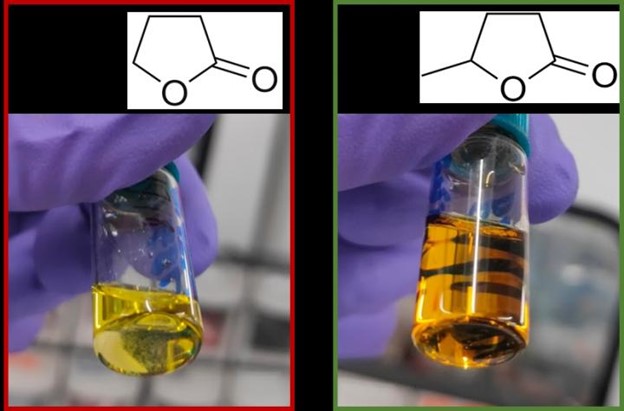
Left - solvent normally used to make solar cells, which is toxic.
Right - new green solvent developed by Swansea University researchers from the SPECIFIC project
| Image Credit: Swansea University
‘This solvent problem was a major barrier, not only restricting large-scale manufacture but holding back research in countries where the solvents are banned,’ said research group leader Professor Trystan Watson. ‘We hope our discovery will enable countries that have previously been unable to participate in this research to become part of the community and accelerate the development of cleaner, greener energy.’
As the conversion efficiency of solar panels improves, cost is also key. What if you could create the same solar panels in a more cost-efficient way? That was part of the thinking behind another recent innovation in Singapore, where Maxeon Solar Technologies has created frameless, lightweight rooftop solar panels. These solar panels can be adhered directly to a roof without racking or mounting systems and allegedly perform just as well as standard solar panels.

The new Maxeon Air technology platform from Maxeon Solar Technologies
‘For close to 50 years, the solar power industry has almost exclusively used glass superstrate panel construction,’ said Jeff Waters, CEO of Maxeon Solar Technologies. ‘As solar panels have increased in size, and the cost of solar cells has been dramatically reduced, the cost of transporting, installing and mounting large glass panels has become a relatively larger portion of total system cost. With Maxeon Air technology, we can now develop products that reduce these costs while opening up completely new market opportunities such as low-load commercial rooftops.’
The idea is to use these peel-and-stick designs on low-load roofs that cannot support the weight of conventional solar systems; and they will be rolled out in 2022. Time will tell whether the innovations in Swansea and Singapore have a bearing on companies’ solar systems, but they provide more evidence of the ingenuity that is making solar power cheaper and more efficient.
24 May 2021 |
|
|
Careers
In the latest blog in our SCI Mid-Career group series, Dr Jessica Gould, Applications Team Leader of Energy Technologies at Croda International, speaks about finding time for career development and the importance of taking on responsibilities outside her normal job role.

Please tell us about yourself and your career journey.
I started off my chemistry career with a Master’s degree in Chemistry from the University of Liverpool, during which I spent a year working in the chemical industry at Cognis Ltd. Following my undergraduate degree, I began a PhD at the University of Nottingham that looked at developing novel coordination polymers for hydrogen storage as part of the Engineering and Physical Sciences Research Council’s Centre for Doctoral Training in Hydrogen, Fuels Cells and their Applications.
After completing my PhD, I started work at Croda in 2013. I have predominantly worked as a research scientist in the UK Synthesis team, specialising in acrylic polymerisation. However, in early 2020 I changed roles to work as the Team Leader of our Energy Technologies Applications team. This area focuses on developing additives for the renewable energy sector, looking at electric vehicles, EV fluids, wind turbines and battery additives.
What are your keys to managing your career at this stage?
Compared to early career development, where the focus is on learning the key skills required for your job, at a mid-career stage other skills such as networking become more important. I do this by attending events both inside and outside my workplace. I also use various online platforms such as Microsoft Teams and LinkedIn to maintain and foster relationships within my network.
I also think that taking on responsibilities from outside your normal job role is important in managing your career at the mid-stage level. This allows you to continue to learn new skills even if you feel you are well settled in your main role. My manager helps me identify these opportunities and manage them within my current job role. My organisation also provides training courses that allow me to further develop these skills.
What challenges are there around mid-career support?
From my perspective, the challenge around mid-career support is finding time within your existing schedule for career development. People can often feel like they’ve stagnated if it takes a long time to progress or if they see limited job opportunities above them. Training, courses, networks and other experiences can help them learn and feel challenged. These provide an excellent way to maintain development at a mid-career level.
What additional support could SCI give to mid-career professionals?
Mentoring is an excellent way for people to feel supported in their career development. Expanding and continuing our mentoring scheme would be a great way for SCI to support its members.
Related Links:
06 May 2021 |
|
|
Energy
Bit by bit, the green hydrogen revolution is coming to our shores. The news that a planning application has been filed for the UK’s largest electrolyser in Glasgow could be a boon for hydrogen evangelists, the local communities, and the political class.
The 20MW electrolyser will form part of the green hydrogen facility on the outskirts of Glasgow near Whitelee, the UK’s largest wind farm. The proposed project would produce up to 8 tonnes of green hydrogen each day – the equivalent of 550 return bus trips from Glasgow to Edinburgh.
If approved, the scheme would be delivered by ScottishPower, BOC, and ITM Power as part of the Green Hydrogen for Scotland Partnership. BOC would operate the facility using solar and wind power produced by Scottish Power and ITM Power would provide the all-important 20 MW electrolyser. Renewable energy would power the electrolyser, which would split the water into hydrogen and oxygen gas. The hydrogen produced by this process could then be used in various applications including transport.
Fundamentally, the people who will benefit most are the people of Glasgow, with the project aiming to provide carbon-free transport and clean air for people across the city area, while satisfying some industrial hydrogen demand. And we can all rest easy now that we know politicians will be pleased about it too, for the project coincides nicely with the United Nations 26th Climate Change Conference, which will be held in Glasgow later this year.

The new facility will be based beside a plentiful renewable energy source, Whiteless wind farm in Eaglesham Moor. | Editorial credit: Maritxu / Shutterstock.com
If all goes swimmingly, the facility will supply hydrogen for the commercial market by 2023. “Whitelee keeps breaking barriers, first the UK’s largest onshore wind farm, and soon to be home to the UK’s largest electrolyser,” says Barry Carruthers, ScottishPower’s Hydrogen Director. “The site has played a vital role in helping the UK to decarbonise and we look forward to delivering another vital form of zero carbon energy generation at the site to help Glasgow and Scotland achieve their net zero goals.”
Tumbling renewable prices
This exciting news follows on the back of some bold green hydrogen claims made in a recent Bloomberg New Energy Foundation (NEF) report: the 1H 2021 Hydrogen Levelised Cost Update. According to Martin Tengler, BloombergNEF’s Lead Hydrogen Analyst, the report authors believe the cost of renewable hydrogen could fall 85% by 2050, 17% lower than they had previously predicted. This, he says, is due to falling renewables prices.

It is becoming cheaper all the time to produce solar and wind power, which is good news for those producing green hydrogen.
Tengler also says that renewable hydrogen should be cheaper than blue hydrogen (when natural gas is split into hydrogen and CO2 via processes such as steam methane reforming) in many countries by 2030. Furthermore, Bloomberg NEF predicts that green hydrogen will be cheaper to process than natural gas in many countries by 2050.
With the prices of solar and wind power constantly tumbling, it would be no surprise to see the authors of these reports revising their projections even further in the coming years. In the mean-time, we welcome the green shoots peeking through outside Glasgow.
15 April 2021 |
|
|
Careers
In this new series, members of the SCI Mid-Career group offer advice on career management and how to overcome career challenges.

In our latest interview, we hear from David Freeman, Research & Technology Director for Croda’s Energy Technologies business.
Please tell us about yourself and your career journey.
After a PhD in organic chemistry, I started my career with ICI Paints in Slough in 1998, working in a product development role. Within a couple of years, I moved to another ICI business, Uniqema, and had various technical roles around the chemical synthesis or process development of new materials.
These early roles – and the people I worked with during this time – had a big impact on me in terms of ways of working and how to deal with people. I subsequently joined Croda in 2006 and have since had further technical roles – initially around the technical management of Synthesis programmes in Croda, then technical management of Applications programmes, and finally on to my current role of R&T Director for Croda’s Energy Technologies business.
This last transition was probably the most interesting and challenging as it forced me to think much more strategically about the “what” rather than the “how” and what leadership versus management was all about. I see this area as being hugely important to the Mid-Career group.
What are your keys to managing your career at this stage?
Development remains really important to me from a personal perspective. I have always driven my own development, but been well supported by the organisations I’ve worked for: both by technical management teams and HR teams. At the mid-careers stage, there are lots of important things to think about but I consider the following to be key:
- (i) Self-understanding and feedback: make sure you understand your strengths and weaknesses and how these manifest themselves with colleagues by seeking open and honest feedback
- (ii) Get external perspectives on your areas of interest and expertise. This for me is really key in challenging thinking and bringing new ways of working and innovation to your role
- (iii) Understand the big picture: make sure you’re clear about what’s going on in the world at a high level and the part you and your organisation have to play in meeting these challenges.
What challenges are there around mid-career support?
I feel very fortunate to have worked for organisations where development is extremely important – support is always on hand when I need it. The key challenge is a personal one and it’s about making enough time to focus on the right development areas. We are all busy but if we want to develop ourselves enough, then we will find that time!
Related Links:
08 April 2021 |
|
|
Sustainability & Environment
When you live in a cold country, you think of hot days as a blessing. Air conditioning units are for those in far-away places – humid countries where the baked earth smell rises to meet you when you step off the plane.
But cooling comes at a cost. According to the UN Environment Programme, it accounts for 7% of global greenhouse gas emissions. Some of us are visual learners; so, the sheer cost of cooling really hit me when I stared up at an apartment building in Hong Kong with hundreds of air conditioning units perched above the windows like birds.
And it isn’t just the Hong Kongers feeling the heat. The cooling industry as a whole is under pressure to cut its greenhouse gas emissions. The International Energy Agency expects emissions from cooling to double by 2030 due to heat waves, population growth, urbanisation, and the growing middle class. By 2050, it forecasts that space cooling will consume as much electricity as China and India do today.

Air conditioning units cling to a building
All of this was captured by the Cooling Suppliers: Who's Winning the Race to Net Zero report released by the Race to Zero campaign, the Kigali Cooling Efficiency Program (K-CEP), Carbon Trust and other partners in the UN Environment Programme-hosted Cool Coalition.
This report's authors found that only five of the 54 cooling companies they assessed have committed to net-zero targets. The document outlines three areas that must be addressed on the Cooling Climate Pathway: super-efficient appliances, ultra-low global warming refrigerants, and the widespread adoption of passive cooling measures such as clever home design and urban planning.
So, while builders adjust window sizes, introduce trees for shading, and choose materials (such as terracotta cooling systems) thoughtfully to temper the sun’s gaze, others are availing of different methods.
For example, the COP26 (the 2021 UN Climate Change Conference) Champions Team has just released its Net Zero Cooling Action Plan that includes a Cool Calculator tool to help companies and governments run simple calculations to see where they could decarbonise their cooling systems. Similarly, the UK's Environmental Investigation Agency (EIA) has launched a net-zero cooling product guide that showcases energy-efficient products run on natural refrigerants.

Green walls are one of many passive cooling approaches used to reduce our reliance on mechanical systems.
However, it’s clear that the softly-softly approach won’t suffice. The EIA has called on governments to do more to encourage organisations to adopt sustainable cooling, to make concrete policy commitments, and speed-up the phase-out of climate-warming refrigerants such as hydrofluorocarbons.
“The development and expansion of net-zero cooling is a critical part of our Race to Zero emissions,” said Nigel Topping, UK High Level Champion for COP26. “In addition to technological breakthroughs and ambitious legislation, we also need sustainable consumer purchasing to help deliver wholesale systems change.”
We all love the technological panacea – innovations that will cure all the climate ills we have inflicted on the world. But the solution will also involve stodgy government regulations and changing consumer habits, and a reliance on the continued fall in renewable power generation.
For those in traditionally cooler climes, it’s no longer someone else’s problem. It was a balmy 22°C in London this week and we’re not even in April yet. So, it’s certainly time to turn up the heat on the cooling industry.
01 April 2021 |
|
|
Sustainability & Environment
What do grape stalks, pineapple leaves, corn cobs, rice husks, sheep’s wool, and straw have in common? Apart from being natural materials, they have all been used to insulate homes. Increasingly, people are turning towards natural, sustainable materials as climate change and waste have become bigger problems.
Existing building insulation materials such as synthetic rock wool are excellent at keeping our homes warm in winter, but the conversation has moved beyond thermal performance. Energy use, re-usability, toxicity, and material disposal are all live considerations now, especially with regulations and emissions targets tightening. So, rock wool might perform better than straw bale insulation but straw is biodegradable, reusable, easy to disassemble, and doesn’t require large amounts of energy to process.
Sheep’s wool and hemp insulation have also become attractive to homeowners and housebuilders alike, but an even more encouraging prospect is the use of waste materials to create next generation insulation. In this spirit, researchers at Flinders University in Adelaide, Australia, have taken waste cooking oil, wool offcuts, and sulphur to process a novel housing insulation material.
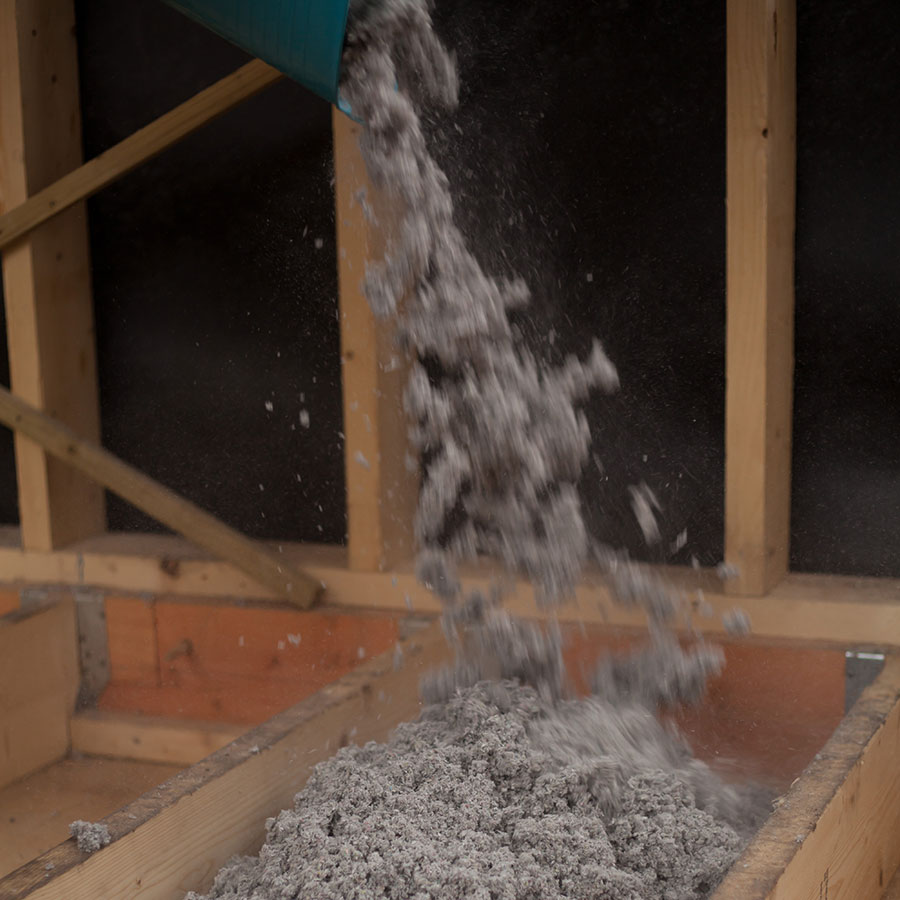
Recycled paper is one of many waste materials that has found its way into domestic insulation.
To make this composite, they followed several stages. In the first stage of the synthesis, the researchers used inverse vulcanisation to create a polysulphide polymer from canola oil triglyceride and sulphur. They then mixed this powdered polymer with wool and coated the fibres through electrostatic attraction. This mixture was compressed through mild heating to provoke S−S metathesis in the polymer and bind the wool. The wool bolsters the tensile strength of the material, makes it less flammable, and provides excellent insulation. The result is a sustainable building material that fulfils its function without damaging the environment.
For Associate Professor Justin Chalker, the lead author of this study, this work provides an ideal jumping-off point. “The promising mechanical and insulation properties of this composite bodes well for further exploration in energy saving insulation in our built environment,” he said.
Sustainable transformation
It is clear that ventures like the one in Adelaide will continue to sprout all over the world. After all, necessity dictates that we change the way we build our homes and treat materials.
A recent report from Emergen Research predicts that the global insulation materials market will be worth US $82.96 billion (£59.78 billion) by 2027. The same report was also at pains to mention that the increasing demand for reduced energy consumption in buildings will be a significant factor in influencing industry growth.
“Market revenue growth is high and expected to incline rapidly going ahead due to rising demand for insulation materials... to reduce energy consumption in buildings,” it said. One of the main reasons given for this increased green building demand was stricter environmental regulations.
And Emergen isn’t the only organisation feeling the ground moving. Online roofing merchant Roofing Megastore, which sells more than 30,000 roofing materials, has detected a shift towards environmentally friendly materials, with many homeowners sourcing these products themselves.

Rock wool insulation panels have come under greater scrutiny in recent times.
Having analysed two years of Google search data on sustainable building materials, the company found that synthetic roof tiles are generating the most interest from the public. Like the Flinders insulation, these roof tiles make use of waste materials, in this case recycled limestone and plastic. And you don’t need to look far down the list to find sustainable insulation materials, with sheep’s wool insulation in 9th place, wood fibre insulation in 10th, and hemp insulation in 12th.
Over time, the logic of the progression towards natural, less energy-intensive building materials will become harder to ignore. “Traditional materials such as synthetic glass mineral wool offer high levels of performance but require large amounts of energy to produce and must be handled with care while wearing PPE,” the company noted. “Natural materials such as hemp or sheep’s wool, however, require very little energy to create and can be installed easily without equipment.”
So, the next time you look down at your nutshells, spent cooking oil, or tattered woollen sweater, think of their potential. In a few years, these materials could be sandwiched between your walls, keeping you warm all winter.
Insulating composites made from sulphur, canola oil, and wool (2021): https://chemistry-europe.onlinelibrary.wiley.com/doi/10.1002/cssc.202100187?af=R
18 March 2021 |
|
|
Energy
A completely clean, renewable energy system that can be produced locally and that can easily power heat, energy storage and transportation, and travel — that's the future that promoters of a hydrogen economy envisage.
If it sounds a bit like rocket science, that's because it is. Hydrogen is what's used to fuel rockets — that’s how powerful it is. In fact, it’s three times more powerful as a fuel than gas or other fossil-based sources. And, after use, it’s frequently converted to drinking water for astronauts.
US President Joe Biden has highlighted the potential of hydrogen in his ambitious plans for economic and climate recovery and a number of recent reports have been encouraging about hydrogen’s breakthrough moment, including McKinsey and Company (Road Map to a US Hydrogen Economy, 2020) and the International Energy Agency.
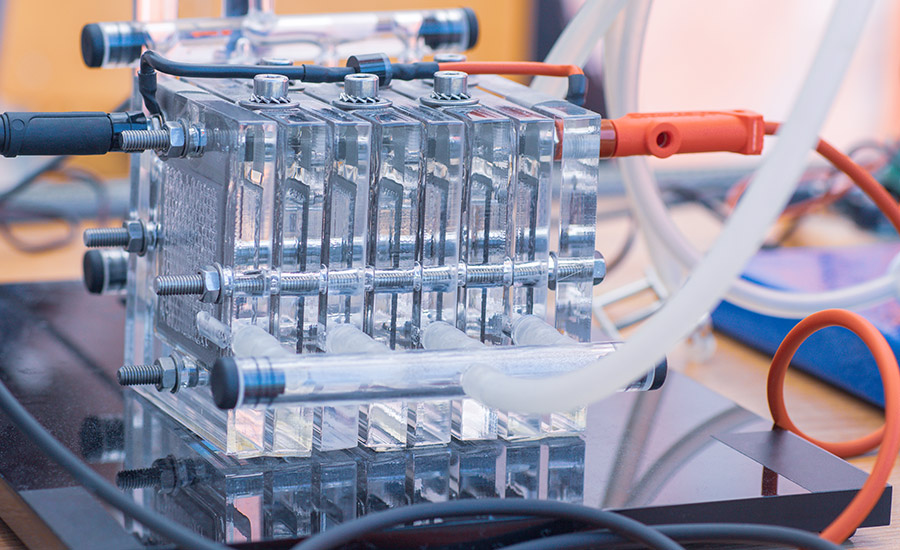
Hydrogen fuel cells provide a tantalising glimpse into our low-carbon future
The McKinsey report claims that, by 2030, the hydrogen sector could generate 700,000 jobs and $140bn in revenue, growing to 3.4 million jobs and $750bn by 2050. It also believes it could account for a 16% reduction in CO2 emissions, a 36% reduction in NOx emissions, and supply 14% of US energy demand.
So how does it work?
Simply put, hydrogen fuel cells combine hydrogen and oxygen atoms to produce electricity. The hydrogen reacts with oxygen across an electrochemical cell and produces electricity, water, and heat.
This is what gets supporters so excited. In theory, hydrogen is a limitless, incredibly powerful fuel source with no direct emissions of pollutants or greenhouse gases.
So what's the problem?
Right now, there are actually a few problems. The process relies on electrolysis and steam reforming, which are extremely expensive. The IEA estimates that to produce all of today’s dedicated hydrogen output from electricity would require 3,600TWh, more than the total annual electricity generation of the European Union.
Moreover, almost 95% of hydrogen currently is produced using fossil fuels such as methane, natural gas, or coal (this is called "grey hydrogen"). Its production is responsible for annual CO2 emissions equivalent to those of Indonesia and the United Kingdom combined. In addition, its low density makes it difficult to store and transport — it must be under high pressure at all times. It’s also well-known for being highly flammable — its use as a fuel has come a long way since the Hindenburg Disaster but the association still makes many people nervous.

A Hydrogen refuelling station Hafencity in Hamburg, Germany. Infrastructure issues must be addressed if we are to see more hydrogen-fuelled vehicles on our roads. | Image credit: fritschk / Shutterstock.com
So there are quite a few problems. What’s the good news?
In the last few years, we've seen how rapidly investment, innovation, and infrastructure policy can completely transform individual renewable energy industries. For example, the IEA analysis believes the declining costs of renewables and the scaling up of hydrogen production could reduce the cost of producing hydrogen from renewable electricity 30% by 2030.
Some of the issues around expense could be resolved by mass manufacture of fuel cells, refuelling equipment, and electrolysers (which produce hydrogen from electricity and water), made more likely by the increased interest and urgency. Those same driving forces could improve infrastructural issues such as refuelling stations for private and commercial vehicles, although this is likely to require coordination between various stakeholders, including national and local governments, industry, and investors.
The significant gains in renewable energy mean that “green” hydrogen, where renewable electricity powers the electrolysis process, is within sight.
The IEA report makes clear that international co-operation is “vital” to progress quickly and successfully with hydrogen energy. R&D requires support, as do first movers in mitigating risks. Standards need to be harmonised, good practice shared, and existing international infrastructure built on (especially existing gas infrastructure).
If hydrogen can be as efficient and powerful a contributor to a green global energy mix as its proponents believe, then it's better to invest sooner rather than later. If that investment can help power a post-Covid economic recovery, even better.
11 March 2021 |
|
|