
Health & Wellbeing
What effect do vaping and air pollution have on your heart, and how could a light-powered pacemaker improve cardiovascular health?
It seems that every day, scientists are learning more about the factors affecting cardiovascular health and are coming up with novel ways to keep our hearts ticking for longer. Here are three interesting recent developments.
A less painful pacemaker
One of the problems with existing pacemakers is that they are implanted into the heart with one or two points of connection (using screws or hooks). According to University of Arizona researchers, when these devices detect a dangerous irregularity they send an electrical shock through the whole heart to regulate its beat.
These researchers believe their battery-free, light-powered pacemaker could improve the quality of life of heart disease patients through the increased precision of their device.

The way existing pacemakers work can be quite painful for heart disease patients.
Their pacemaker comprises a petal-like structure made from a thin flexible film (that contains light sources) and a recording electrode. Like the petals of a flower closing up at night, this mesh pacemaker envelops the heart to provide many points of contact.
The device also uses optogenetics – a biological technique to control the activity of cells using light. The researchers say this helps to control the heart far more precisely and bypass pain receptors.
‘Right now, we have to shock the whole heart to do this, [but] these new devices can do much more precise targeting, making defibrillation both more effective and less painful,’ said Igor Efimov, professor of biomedical engineering and medicine at Northwestern University.
‘Current pacemakers record basically a simple threshold, and they will tell you,’ added Philipp Gutruf, lead researcher and biomedical engineering assistant professor. ‘This is going into arrhythmia, now shock, but this device has a computer on board where you can input different algorithms that allow you to pace in a more sophisticated way.’
Another potential benefit is that the light-powered device could negate the need for battery replacement, which is done every five to seven years. That use of light to affect the heart rather than electrical signals could also mean less interference with the device’s recording capabilities and a more complete picture of cardiac episodes.

The device uses light and a technique called optogenetics, which modifies cells that are sensitive to light, then uses light to affect the behavior of those cells. Image by Philipp Gutruff.
>> See how Bright SCIdea winner Cardiatec uses AI to improve heart disease treatment.
The danger of vaping?
We don’t know a lot about the long-term effects of vaping because people simply haven’t been doing it long enough, but a recent study from the University of Wisconsin (UW) suggests that it could be bad for the heart.
Researchers selected a group of people who had used nicotine delivery devices for 4.1 years on average, those who smoked cigarettes for 23 years on average, and non-smokers and compared how their hearts behaved after smoking (the first two groups) and after exercise.
The researchers noticed differences minutes after the first two groups smoked or vaped. ‘Immediately after vaping or smoking, there were worrisome changes in blood pressure, heart rate, heart rate variability and blood vessel tone (constriction),’ said lead study author Matthew Tattersall, an assistant professor of medicine at the University of Wisconsin School of Medicine and Public Health.

The lack of long-term data means we still don’t know the effect of vaping.
Those who vaped also performed worse on the four exercise parameters compared to those who hadn’t used nicotine. Perhaps the most startling finding was the post-exercise response of those who had vaped for just four years compared to those who had smoked tobacco for 23 years.
‘The exercise performance of those who vaped was not significantly different from people who used combustible cigarettes, even though they had vaped for fewer years than the people who smoked and were much younger,’ said Christina Hughey, fellow in cardiovascular medicine at UW Health, the integrated health systems of the University of Wisconsin-Madison.
The influence of lead and air pollution
We know that smoking and passive-smoking are bad for our hearts, but some overlook the effect of other environmental toxins, especially those common to specific geographical regions.
A collaborative study including US and UK researchers has found a divergence in the types of environmental contaminants that contribute to cardiovascular ailments in both countries, aside from the prevalent smoking-related heart disease.

Hopefully, the growth in electric vehicle use will reduce air pollution
The study found that lead-related poisoning is more common in the US, whereas air pollution has a more damaging effect in the UK due mainly to increased population density. The researchers found that 6.5% of cardiovascular deaths were associated with exposure to particulate matter over the past 30 years compared to 5% in the US.
The one plus is that research has found that there has been a steady decline in cardiovascular deaths stemming from lead, smoking, secondhand smoke and air pollution over the past 30 years. Nevertheless, it will be of little comfort to those walking in the trail of exhaust fumes in cities.
‘More research on how environmental risk factors impact our daily lives is needed to help policymakers, public health experts, and communities see the big picture,’ said lead author Anoop Titus, a third-year internal medicine resident at St. Vincent Hospital in Worcester, Massachusetts.
14 December 2022 |
|


 |
|

Careers
In the second part of our chat with Bright SCIdea finalist Team Eolic Wall, we found out how they prepared for their presentation and judges’ questions, and what’s next for their innovative wind turbine technology.
The road from Eureka moment to finished product is paved with peril. Team Eolic Wall’s idea for small, modular wind turbines that use magnetic levitation to harness more power than existing turbines could bring wind power generation into our very homes. But bringing a groundbreaking product to market is not just about mastering the science. It must make business sense too.
As with the other Bright SCIdea hopefuls, Team Eolic Wall received free training from SCI in the form of online tutorials from experienced professionals including modules on structuring a business, financial modelling, branding, and marketing.

After completing the training, Eolic Wall rose to meet the challenge. The team qualified for the Bright SCIdea final and, with it, the pivotal presentation in front of a live audience and panel of expert judges.
Many of us take it as a given that we speak to people at work in our native tongue. The nuances of communication – the cultural subtleties and oddities of the English language – aren’t a concern. But Team Eolic Wall had to present in their second language.
Pitch perfect?
‘This was not our first international presentation, but it was the first one in a foreign language,’ said Alfredo Calle, Eolic Wall founder, ‘so that's always a little bit intimidating until one gets used to it.’
The key to them nailing the pitch was in the spade-work. Calle and his colleagues rehearsed the speech until they knew it by heart. ‘It’s all about training and preparation,’ he said. ‘The more you rehearse, the more confident you feel when the presentation moment comes.’
Of course, the presentation is predictable but the judges’ questions are less so. Having undergone the rigours of competition, Calle recommends that this year’s entrants prepare by trying to predict the types of questions they will be asked. A cold rehearsal could help with the potentially stunning situation of someone throwing questions at you from strange angles.
That team Eolic Wall presented its technology online made theirs even trickier still, especially given a technical hitch at the beginning. But they had polished the presentation to a smoothness that offset such difficulties and came away as joint winners of the Audience Award.
The only lingering regret for them was that Covid prevented them from coming to London. ‘We wish we could have made it to the final,’ he said. ‘Facing the judges and audience live would have been a tremendously valuable and enriching experience.’
A wind energy democracy
Since the Bright SCIdea final, the Eolic Wall is being built brick by brick. The team has received three grants in recent months including one from ProCiencia, the largest innovation agency of the Peruvian government.

Eolic Wall's wall-mounted wind turbine is designed to power homes and offices in situ.
However, perhaps the most exciting development is the technology itself. ‘We have accomplished a peripherally supported wind turbine that works with magnetic levitation,’ Calle said. ‘That's a huge milestone that makes us believe we are building something big.’
Calle hopes for more investment to develop the technology further. At heart, he believes the Eolic Wall will give regular people the chance to generate affordable wind energy from home.
‘We are working out a solution to democratise wind energy for the sake of this blue rock we call home.’
>> Find out how Team Eolic Wall’s innovative technology in part 1 of this blog.
01 November 2022 |
|
|
Careers
Imagine owning a small wind turbine that generates all of your home’s energy needs. As the clock counts down on entries for for the 2023 Bright SCIdea Challenge, we caught up with Team Eolic Wall, the Audience Winner for the 2022 competition.
Eolic Wall was always a nice fit for Bright SCIdea. The team spotted a problem in our renewable energy mix and came up with a scientific business idea to solve it. They saw that wind energy is generated for the public, but it isn’t generated by the public. This stands in bright contrast to solar power generation.
‘Today, 40% of all installed capacity in solar energy is based on solar panels installed on the rooftops of home and corporate buildings,’ said Alfredo Calle, founder of Eolic Wall. ‘The remaining 60% correspond to solar farms.’

Eolic Wall's wall-mounted wind turbine is designed to power homes and offices in situ.
The wind industry is different. ‘Only 1% of the installed capacity comes from households and businesses,’ he added. ‘That is, 99% of all installed capacity in the world comes from wind farms. That sort of concentration is a problem that hampers the energy transition.’
Calle believes this disparity hampers the move from fossil fuel dependency to clean, renewable energy. For many, micro-generation is key. We need to put power – renewable power – in the hands of the people. His idea is to make wind energy available in the home, just as solar exists on roofs everywhere.
The scale of this task is daunting. It turns out there’s a reason why we don’t all have wind turbines bolted onto our homes. The problem, Calle argues, is that a windmill must be large to be efficient.
He believes the Eolic Wall could change that – that this wall-mounted wind turbine is efficient enough to power our homes and offices.
‘We have created a technology that not only doubles wind speed to harvest more power from the same wind resources, but also has a wind turbine that works with magnetic levitation to almost eliminate any friction.’
From applicant to finalist
So, how did a team based out of the National University of Engineering in Peru and Universidade Estadual Paulista in Brazil end up competing for the £5,000 first prize in the Bright SCIdea final?
Chance. Fortune. Happenstance. Calle and his colleagues came upon Bright SCIdea through a social media post that immediately captured their attention.

‘We thought that the Eolic Wall was ideal for Bright SCIdea because of the huge positive impact that this technology could have,’ he said, ‘and also because it perfectly fit into Bright SCIdea’s thesis of supporting ideas in the intersection of business, innovation and science.’
Applying was simple, although the business plan submission was intimidating at first. However, like all BrightSCIdea applicants they received coaching, and their brainchild found form.
‘The key driver to overcome that challenge was not to miss any training sessions and tutorials,’ Calle said. ‘The good news is that after going through the whole process you feel that everything was worthwhile. No pain, no gain.’
Check out fellow 2022 finalist Klara Hatinova from Team Happy BioPatch in conversation with the Periodic Fable podcast.
20 October 2022 |
|
|
Sustainability & Environment
Have we underestimated the eco-anxiety middle-aged and older people feel? According to a recent survey, younger folks aren’t the only ones frowning at the horizon. Eoin Redahan writes.
When you think of a middle-aged person suffering from exo-anxiety, what do you imagine? Is it a grey-haired woman gazing from a mountain peak with a single, heroic tear staining her cheek? Is it an auld fella rending his garments and shaking his fist at the sun?
I mean, possibly, but the reality is probably less dramatic. It could be the Pakistani householder who wonders if her family home will be swept away in the next flood. It might be the 39-year-old Australian who wonders if his country will be habitable when his young child grows up.
It might be the Maldivian who wonders if his homeland will go the way of Atlantis within 20 years. It was me when someone decided it would be a good idea to have a barbecue in the fields beside my house in the middle of the heatwave – when the grass was as dry as straw and wildfires scorched in south London.

Athanasius Kircher's map of Atlantis, placing it in the middle of the Atlantic Ocean, from Mundus Subterraneus, 1669. Will people pore over maps of the Maldives in the same way?
The presumption by many is that it’s only the young who feel anxious about climate change, for it is they who will inherit the mess. However, according to recent ONS statistics, the middle-aged and the old are almost as worry-weary as young people.
Having analysed a recent ONS Opinions and Lifestyle Survey, straw specialist firm Drinking Straw filtered some of the stats. They reveal that 62% of UK people over the age of 16 worry that rising temperatures will directly affect them by 2030. Of these, 70% of 16-29 year olds were worried about the heat, but 59% of 50-69 year olds were also worried, as were 57% of those aged 70 and over.
In other areas, the differences were even less stark. When it came to anxiety over extreme weather events, 48% of all adults were worried – only slightly less than the 49% of 16 to 29 year olds who did so.
>> How can I make my garden more sustainable? Professor Geoff Dixon shows us how.
Similarly, regarding water supply shortages, 40% of all adults are concerned about them overall, compared to 43% of those aged 16 to 29. Admittedly, young people are more worried than older adults about rising sea levels (45% vs. 31%), but the differences are noticeably narrow in most metrics.
Surprisingly, it turns out the percentage of those who don’t care at all about the merciless heat, parched land, rising sea levels, and freak weather events is fairly consistent across all segments, with the 12% of 16-29 year olds not giving a fig similar to the 14% of indifferent adults.

ONS figures reveal that most people have made climate-friendly changes to their day-to-day lives, whether they grew up in the age of renewables or the age of coal.
Action stations?
Broadly speaking, UK adults are becoming more eco-conscious, if data from the ONS’ Climate change insights, families and households, UK: August 2022 survey are to be believed. The survey has found that 77% of adults have made some, or a lot of changes, to their lifestyles to tackle climate change.
When the remaining 23% were asked why they made no change to their lifestyles, the most common reason given was: the belief that large polluters should make changes before individuals, followed closely by those who felt that individual change wouldn’t make much of a difference.

It’s clear to most of us that the government must help drive change, including on our roads. Despite the UK’s lagging electric vehicle infrastructure, the study revealed that the number of licensed zero emission vehicles, ultra-low emission vehicles, and plug-in vehicles increased by 71% or more last year.
If people knew there were sufficient charging points dotted around their areas – and if they were further incentivised to give up their gas-guzzling vehicles – those numbers would surely increase.
As bleak as the situation is, it is heartening to see our attitudes changing. Now, if you’ll excuse me, I’ve just read a climate-related story that brought a tear to my eye. If anyone wants me, I’ll be weeping in a dark room (passive-cooled, mercifully).
05 September 2022 |
|
|
Agrifood
Which species can you plant to increase the nutrients in your soil and boost biodiversity, and which pathogen tackles some of those pesky weeds? Our resident gardening expert, Professor Geoff Dixon, tells us more.
The term ‘sustainability’ for gardening means replacing what you take out of the soil and supporting localised biodiversity. Harvested crops, for example, take out nutrients and water from the soil. Replacements should be supplied that aid biodiversity and have minimal impact, or zero impact, on climate change.
Seaweed (Ascophyllum) has been recognised as a valuable fertiliser source in British coastal areas for centuries. Now, proprietary seaweed extracts are gaining popularity either when applied directly as liquid feeds or sprays, or when added into composts.
Classed as biostimulants, seaweed extracts contain several micro-nutrients and a range of valuable plant stimulatory growth regulators. They encourage pest and disease tolerance, increase frost tolerance, stimulate germination, increase robust growth, and add polish to fruit such as apples and pears.

Seaweed bolsters some of the nutrients lost through gardening. Image from Geoff Dixon.
Benefits of borage
Some plants are very effective supporters of biodiversity. Borage (Borago officinalis), known also as starflower or bugloss, is a robust annual plant of Mediterranean origin with pollinator-attractive blue flowers.
It is very drought resistant and suitable for dry gardens. Although an annual, it is self-seeding and could spread widely. It is very attractive to bees as it produces copious light – and delicately flavoured honey.
Its flowers and foliage are edible with a cucumber-like flavour, making it suitable in salads and as garnishes, while in Germany it is served as grűne soße (green sauce). When used as a companion plant for crops such as legumes or brassicas, it will also help to suppress weeds.

Borage is good for bee and belly. Image from Geoff Dixon.
Weeding out the problem
Weeds are a continuous problem for gardeners and their prevalence varies with the seasons. Groundsel (Senecio vulgaris), also known as ‘old man in the spring’, persists whatever the weather.
It is ephemeral but can seed and regrow several times per year. As a result, once established, it is difficult to control without very diligent hand weeding and hoeing out young seedlings before the flowers form.
There is, however, a form of biological control that can aid the gardener. Groundsel is susceptible to the fungal rust pathogen (Puccinia lagenophorae). This pathogen arrived in Great Britain from Australia in the early 1960s. Since then, it has become well established and outbreaks on groundsel start to become obvious in mid- to late-summer, especially in warm dry periods.

A fungal pathogen can kill groundsel, a weed that comes through several times a year. Image from Geoff Dixon.
Severe infections weaken, and eventually kill, groundsel plants. Gardeners should take advantage of the infection and remove the diseased weeds before any seeds are produced.
>> How else has climate change changed the way our gardens grow, and what can be done to alleviate its effects? Geoff Dixon investigates.
Professor Geoff Dixon is author of Garden practices and their science, published by Routledge 2019.
Written by Professor Geoff Dixon. You can find more of his work here.
15 August 2022 |
|
|
Careers
Paulina Quintanilla has developed a clever way to maximise the froth flotation technology used to extract more valuable minerals from rocks. The SCI Scholar and Poster Competition winner chatted to us about her process and how it could make mineral processing more efficient.
How would you describe your froth flotation technology in simple terms?
Froth flotation is the most widely used technology to separate valuable mineral particles from waste rock. The process is carried out in stirred tanks in which chemical reagents and air are added. Some of these reagents, called collectors, make the valuable mineral particles hydrophobic, which means that they repel water.
Consequently, the valuable mineral particles attach to the air bubbles, covering them and generating bubble-particle aggregates. The bubble-particle aggregates rise to the top of the tank, forming a froth that overflows as a mineral-rich concentrate, while the waste rock leaves from the bottom of the tank as tailings.
Froth flotation is also relevant in several other industrial applications, such as water treatment and paper de-inking.
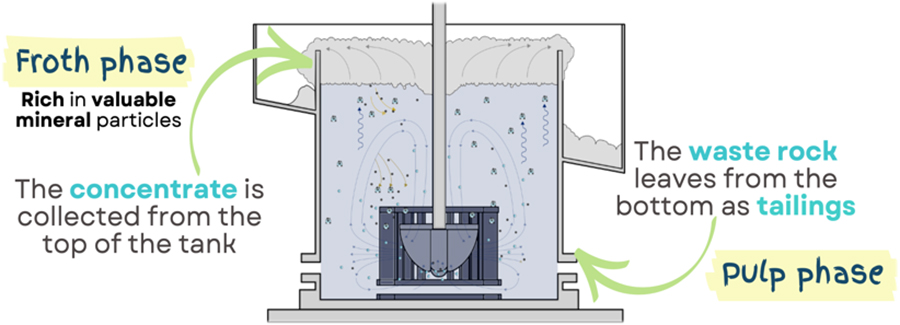
Schematic of the froth flotation process. Image by @AMPRG_Imperial.
How would you describe your froth flotation technology in simple terms?
This research focuses on optimising the froth flotation process using a control strategy called model predictive control. To this end, mathematical models were developed to represent the phenomena inside a flotation tank. These models are then used to ‘predict the future’ so that decisions can be taken now (we can control the process) to improve the froth flotation performance.
Model predictive control is a powerful optimisation strategy that has been widely used in other processes, including in the petrochemical industry, but it is still very new in the mineral processing industry.
One of the main advantages of this research is that the models are physics-based. This means that they were developed from the fundamental physics of the process rather than from data, which makes them useful under any operating conditions, for any flotation tank size. This is particularly interesting for application in the large flotation tanks used on an industrial scale.
How could this work benefit industry and make processing more efficient?
Building clean technologies for the transition to 100% green energy is creating a massive demand for a range of minerals. For example, copper mines would have to ramp up production considerably to satisfy the extra 7% predicted demand. Meeting that demand, however, is becoming more and more challenging as ores are becoming lower grade, deeper, and more complex.
This implies that there is an urgent need to optimise current processes to extract the necessary minerals and metals more sustainably and efficiently. As froth flotation is a large-scale process, even small improvements in the separation efficiency would translate into important increments in production.
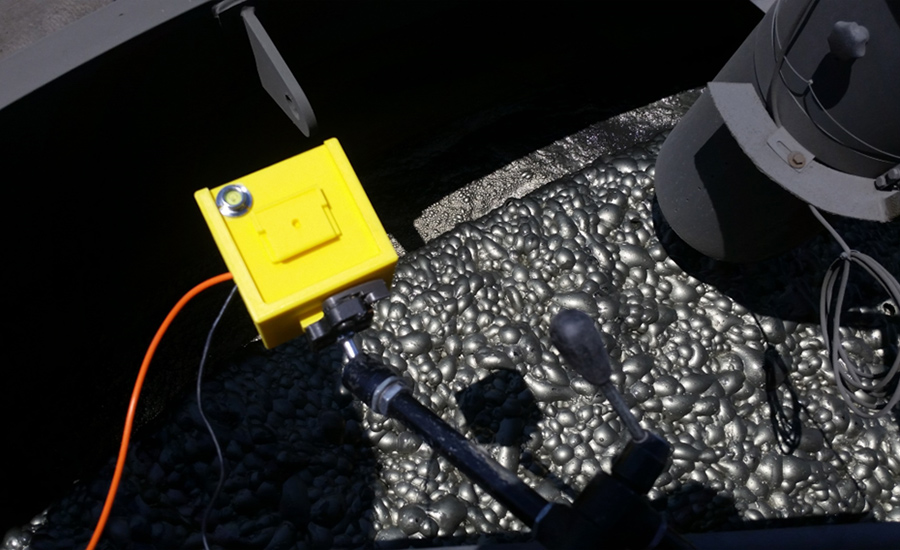
Overflowing froth seen from the top of an industrial-scale tank. Image by @AMPRG_Imperial.What is the potential of this work in terms of copper recovery?
We demonstrated that improvements of between 8 to 22% in metal recovery were achieved by implementing a model predictive control strategy at the laboratory scale, revealing an untapped potential for implementation at an industrial scale. This research could serve as a promising next step for the mining industry to meet future metal and mineral demands by extracting more metal for the same amount of resources, such as water, energy, and chemicals.
>> Interested to find out more about SCI Scholarships?
Your flotation tanks are actually based in Chile. How do you operate them remotely?
I am currently implementing an online model predictive control strategy in a laboratory-scale flotation bank in Chile. I monitor and control this experimental rig from home, in the UK.
The experimental rig was automated in such a way that all the instruments (e.g. air flow meters, controllers, pumps, etc.) are connected to a module called ‘Programmable Logic Controller’. This module is then connected to a workstation computer, which I access from my laptop in the UK.
The Programmable Logic Controller allows me to obtain measurements in real-time and control the system. In this case, the measurements are used to update the mathematical models, while the system is controlled by changing the ‘revolutions per minute’ of the pumps (to change the pulp levels) and/or moving the air valves (to change the airflow rates).
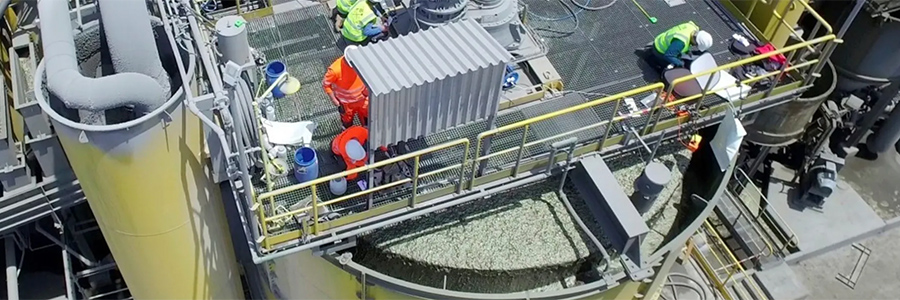
Experimental campaign in 2018 – aerial view of a 300m³ froth flotation tank. Image by @AMPRG_Imperial.
Could this process be used to extract other materials? If so, which ones?
While froth flotation is widely used to separate sulphide minerals of copper, it is also used to separate other sulphides, such as those containing lead, zinc, and molybdenum.
You won an SCI Scholarship. How did you use the funds you received to develop your research?
I used the generous SCI scholarship to partially fund a two-month visit to the laboratory in Chile. I set up new connections for remote control by installing new instrumentation to make it even more automated, and I carried out preliminary online control experiments. Since then, all the control experiments have been carried out from my laptop at home.
I also used the scholarship to fund my participation in several conferences, including one in person in Athens, Greece, in 2021. I have participated in Scholar Days in 2020 and 2021, in which I presented advances in my PhD research to a wide audience. This year, I presented my PhD research results at SCI headquarters for the first time and participated in the Poster Showcase, where I won first place.
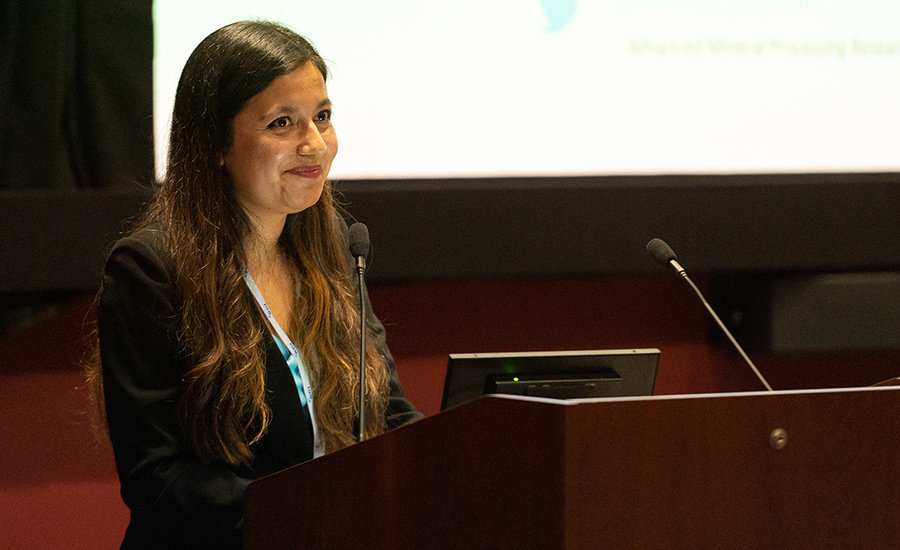
Paulina presenting at the SCI Scholars' Showcase in July 2022. Image: SCI/Andrew Lunn
What are your future plans for this innovative technology (and other potential research)?
I plan to keep up the momentum of researching froth flotation optimisation, as I believe that there is still a long way to go for improvement, particularly at an industrial scale. Model predictive control has not been widely explored within the mineral processing industry despite the fact that it has shown great potential. There is still a gap between academia and industry that should be bridged, sooner rather than later, to improve the performance of the process.
Apart from the model predictive control strategy using physics-based models (including the one I have investigated during my PhD research), many other control strategies show great potential to be tested and implemented at an industrial scale.
This is particularly applicable in mineral processing plants, as most of them collect a huge amount of data that could serve as valuable inputs for further improvement and optimisation, using novel engineering tools such as artificial intelligence and digital twins.
Paulina is part of the Advanced Mineral Processing Research Group at Imperial College London, whose research includes fluid dynamics of flotation tanks and multi-criteria decision-making for sustainable mining and mineral processing.
03 August 2022 |
|
|
Science & Innovation
A range of greenhouse gas removal technologies may be necessary if we’re to reach Net Zero by 2050. In the second of our two-part geoengineering feature, Eoin Redahan looks to the sea, the sun, and mineral weathering, and at the ethical concerns such technologies raise. Missed Part One? Find it here.

‘Water, water, everywhere, nor any drop to drink.’
These famous words from Samuel Taylor Coleridge’s Rime of the Ancient Mariner aren’t the only famous part of his epic poem. The term albatross around one’s neck comes from it too.
After shooting a friendly albatross at sea, the poem’s narrator was forced by the ship’s crew to wear the dead creature around his neck – and grievous luck was to follow. Well, our blue planet has an albatross around its neck in the form of climate change.
Perhaps the solution to it lies all around us – water, water, everywhere…
An ocean of potential
In theory, we can use our oceans to pull CO2 from the air on an enormous scale. All it may take is clever intervention – potentially ruinous, albatross-shooting intervention.
Nevertheless, the World Economic Forum lays out the tantalising potential. ‘Ocean-based CO2 removal can help us achieve “net negative emissions” as the seas hold 50 times more carbon than the atmosphere,’ it says.
‘The ocean [is] a sink for nearly one third of anthropogenic carbon emissions and more than 90% of the resulting heat… If we are going to manage atmospheric CO2 levels to our advantage, we will need to leverage the ocean’s existing ability to govern the global carbon cycle.’
Frontier has targeted the development of scalable sources of alkalinity. The reasoning behind it is that with CO2 being an acidic molecule, rising CO2 concentrations could be neutralised through alkalinity. It has mentioned using mine tailings to remove up to 0.5 gigatonnes of CO2 from the air each year; but the major caveat here is that it needs to be done safely.
Planetary Technologies has ventured into this space armed, essentially, with a bicarbonate of baking soda that could draw in CO2 and sequester it for millenia.
The company explains its process: ‘We start by carefully extracting key parts of the mine tailings including recovering battery metals (like nickel and cobalt) and silica (sand) and then take the remaining purified metal salt solution into a special electrolyser. There, using clean, renewable electricity, the salt and water are split to make hydrogen (a clean, emissions-free fuel), and a pure alkaline hydroxide.
‘It’s from this point that we transport the bulk alkaline materials to our ocean outfalls site where the alkalinity is introduced to the surface ocean that then draws in CO2, sequestering it as already abundant bicarbonate and carbonate ions in seawater.’
So, by decreasing the acidity of the ocean, it would have a greater capacity to absorb CO2 from the air. The key, however, is to reduce this to a viable price point.
>> Want to read about iron fertilisation in our oceans? Rhiannon Garth Jones took a closer look here.
Mineral weathering, methane capture, and more
Mineral weathering is another contender in the CO2 removal mix. One technology that recently received $2.4m in funding is Seattle-based Lithos’ enhanced weathering process – a mineral weathering process that could capture CO2 at a gigatonne scale. According to Frontier, Lithos spreads basalt on croplands to increase dissolved organic carbon, before eventually being stored as ocean bicarbonate. The idea is to maximise CO2 removal while bolstering crop growth.
Closer to home, SAC Consulting in Edinburgh will receive £2.9m to capture the methane produced by cattle and cut emissions from the livestock farming sector; Synthetic Biology in San Francisco has received an R&D grant to synthesise a polymer within algae that is capable of sequestering atmospheric CO2 at a large scale; and Charm Industrial is converting plants into a carbon-rich liquid that is pumped underground.
To do the latter, Charm grows cellulosic biomass that captures CO2 from the atmosphere. It is then harvested, ground, and heated, before being turned into a bio-oil that is pumped underground.
Even the concrete beneath our feet could be used as a carbon sink. CarbonCure is injecting CO2 into its concrete mixes, which it says is not only comparable in cost to traditional concrete, but stronger.
And then, we have solar engineering – arguably the first technology that comes into many of our minds when we think of carbon removal. All sorts of geoengineering technologies exist in this sphere including cirrus cloud thinning, stratospheric aerosol scattering, and marine cloud brightening.
Ethical issues?
Interestingly, Harvard’s Solar Geoengineering Research Programme referred to geoengineering as ‘a set of emerging technologies that could manipulate the environment and partially offset some of the impacts of climate change’.
Therein lies the problem for many. What are the consequences of ‘manipulating the environment’, especially if these technologies fall into unscrupulous hands?
In her excellent blog for SCI on geoengineering, Rhiannon Garth-Jones referred to the Haida Corporation Salmon trial. In this trial, 120 tonnes of iron compound were deposited in the migration routes of pink and sockeye salmon in the Pacific Ocean, which resulted in a several-month-long phytoplankton bloom.
It was seen by many as a success. The phytoplankton fed fish and increased biodiversity and the iron sequestered carbon; but Environment Canada believed the corporation violated national environmental laws by depositing iron without a permit.
History teaches us that profit vs. planet tussles don’t always go the way we would like, and the consequences of these technologies going into the wrong hands could be catastrophic.
On 29 June, The World Economic Forum called for a code of conduct for ocean-based CO2 removal; and the American Geophysical Union, a group of climate and planetary scientists, is leading the way in developing an ethical framework for climate intervention engagement.
We’re all feeling the effects of climate change. As I write this piece on 19 July, it is 39°C here in Greenford, London. 39°C in London! The earth is cracking, planes are circling (because the runways are melting), and grass fires are blazing in Croydon.
On days like today, it feels like we need all the innovation we can get.
29 July 2022 |
|
|
Science & Innovation
Many believe that greenhouse gas removal technologies will be necessary if we’re to reach net zero by 2050. In the first of our two-part geoengineering feature, we look at some of the difference-makers.
This week, a friend of mine played a tennis match just north of London. The game was due to take place at 18:00 but was deferred for an hour because it was 39°C. This came a day after Rishi Sunak, who may become the UK’s next Prime Minister, warned about going ‘too hard and too fast’ on net zero measures.
It’s looking increasingly likely that the implementation of environmental policies isn’t happening quickly enough; so, if we want to avoid catastrophic climate change, we will need to develop technologies that pull carbon dioxide from the atmosphere.
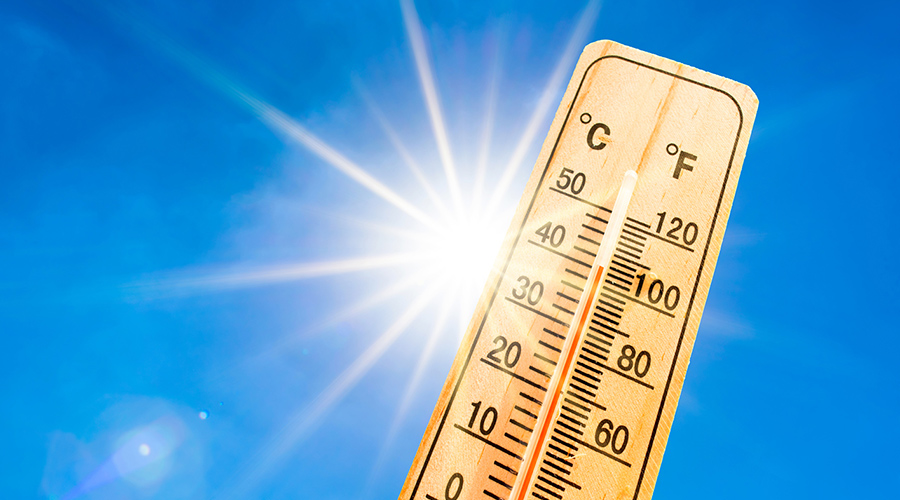
Mercury rising: the UK recorded record high temperatures this week.
Certainly, that’s the UK government’s perspective. ‘Greenhouse Gas Removal technology will be essential to meeting the UK’s climate change target of net zero carbon emissions by 2050,’ it said. ‘These technologies will be necessary to offset emissions from hard to decarbonise areas, such as parts of the agriculture and aviation sectors.’
Thankfully, work is underway to make this happen. And it is more than just the pang of the environmental conscience that has stirred the private sector into action. There is much money to be made from geoengineering. Indeed, a CNBC story has estimated that it could be a trillion dollar market by 2050.
The public investment has been relatively modest by some. The UK government recently pledged £54m in funding towards 15 different carbon removal technologies. But some in the private sector have dollar signs in their eyes.
A collaborative called Frontier – funded by Stripe, Alphabet, Shopify, Meta, McKinsey, and tens of thousands of businesses using Stripe Climate – has made an advance market commitment to spend an initial $925m on permanent carbon removal technologies between 2022 and 2030.
‘Models project that by 2050 we will need to permanently remove billions of tons of CO2 from the atmosphere every year,’ it states. ‘To date, fewer than 10,000 tons have been removed in total.’ The capital it has committed is designed to help companies developing carbon removal solutions to scale up.
The UK government has mentioned the need for a portfolio of carbon removal technologies to reach net zero. A cursory look reveals that there are many from which to choose, including direct air capture, the manipulation of the sea, advanced weathering, and solar engineering.
These methods are audacious, exciting, and controversial.
Direct air capture
The key, as ever, is to come up with low-carbon technologies that are both effective and economically viable. In that respect, direct air capture has emerged as a front runner. This technology often uses giant fans with filters, or chemical processes, to take CO2 from the air.
The difficulty is the amount of energy needed to power these processes and the source of this energy. The cost of removing each tonne of CO2 is also an impediment to growth – something that will need to fall for it to be implemented on a large scale.
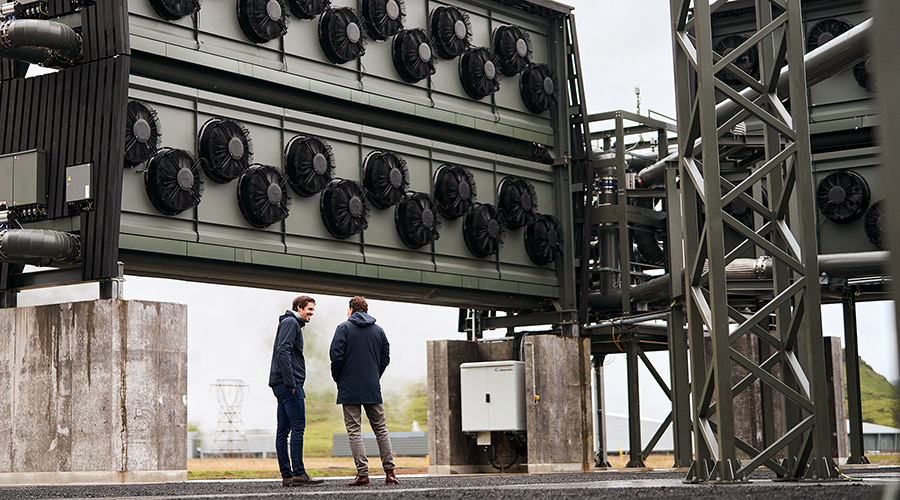
Climeworks co-founders Jan Wurzbacher and Christoph Gebald at the Orca plant in Iceland. Image courtesy of Climeworks.
Nevertheless, significant strides have been made in recent times. Swiss company Climeworks raised US$650m in equity for its largest direct air capture plant, and last week it inked a 10-year deal with Microsoft to permanently remove 10,000 tonnes of CO2 emissions from the atmosphere on its behalf.
The company’s machines capture CO2 from ambient air by drawing air into the collector with a fan. The CO2 is captured on the surface through a selected filter material that sits inside the collectors. Once the filter is filled with CO2, the collector is closed, and the temperature is increased to 80–100°C, whereupon the CO2 is released.
And what becomes of the CO2 after that? The CO2 at its Orca facility (50km outside Reykjavík, Iceland) will be mixed with water and pumped deep underground. The carbon dioxide will then react with the basalt rock through natural mineralisation and turn into stone.
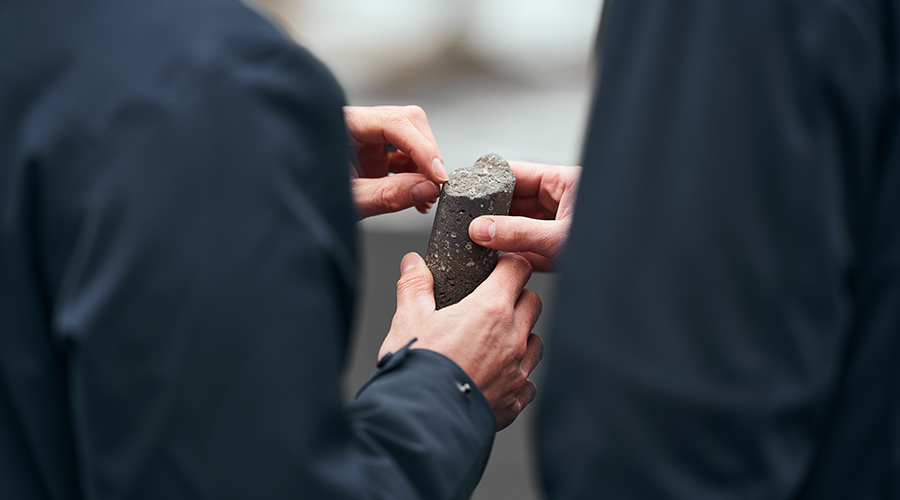
Climeworks CO2 turned into stone via Carbfix technology. Image courtesy of Climeworks.
And Climeworks isn’t the only one operating in this space. As part of the UK Government’s aforementioned £54m funding, London-based Mission Zero Technologies will receive £2.9 million to build a low-energy, heat-free way to pull CO2 from the air.
Sydney-based AspiraDAC has been backed by the Stripe Climate Fund to remove 500 tonnes of CO2 using its modular, solar-powered system. According to Frontier: ‘Its MOF (metal-organic framework) sorbent has low-temperature heat requirements and cheap material inputs, increasing the likelihood that AspiraDAC can help accelerate the production of lower-cost metal-organic frameworks which, historically, have been expensive and difficult to synthesise.’
The Stripe Climate Fund has also backed 8 Rivers Capital, LLC, and Origen Carbon Solutions, Inc to remove CO2 from the air using its direct air capture (DAC) technology. Frontier said: ‘The DAC technology accelerates the natural process of carbon mineralisation by contacting highly reactive slaked lime with ambient air to capture CO2. The resulting carbonate minerals are calcined to create a concentrated CO2 stream for geologic storage.’
Of course, direct air capture is just one of many CO2 removal solutions. In part two, next week, we’ll look at other promising technologies.
22 July 2022 |
|
|
Sustainability & Environment
What is the verdict on the 100% sustainable fuel Formula 1 plans to use in its cars, and is the new E10 fuel this season doing any good? We asked David Bott, SCI’s Head of Innovation.
Beware of Greeks bearing gifts. This phrase comes from Virgil’s Aeneid, and it refers to the Greeks’ gift of a giant wooden horse to their enemies during the Trojan War. But this was no gift at all.
This warrior-filled, hollow wooden horse that the Trojans wheeled inside the gates of Troy was a ploy from the Greeks to get inside the city’s impenetrable city walls and ambush their enemy. It turned out things weren’t quite what they seemed.
Just as Trojans became wary of giant wooden horses, we should be wary of Net-Zero pledges. These promises seem impressive but, if you look inside, they might not be quite as beneficial to the environment as advertised – at worst, they could be hollow.
Whenever an organisation talks of carbon credits, makes a vague reference to biomass or a grand pledge with little detail, it is worth closer investigation.
Formula 1 recently made a sustainability pledge of its own. Following its decision to use E10 fuel in the cars this season (a mixture of 90% fossil fuel and 10% ethanol), it has announced plans to use a 100% sustainable drop-in fuel in its vehicles as part of its plans to reach Net-Zero by 2030.
On first reading, the terms Net-Zero and Formula 1 don’t sit easily together. Isn’t this the sport where 20 cars can burn more than 100kg of fuel each per race? The same travelling circus in which cars, teams, and drivers are flown and ferried all over the world for more than eight months of racing?
By its own calculation, in a November 2019 report, Formula 1 is responsible for 256,551 tonnes of carbon dioxide emissions each year. To put that figure into perspective, you would need to drive for 6,000km in a diesel car to generate a single tonne of carbon emissions – multiply that by 256,000, and Net-Zero feels some distance away.
What about the E10 and proposed drop-in fuels?
Both Formula 1’s new fuel and pledges merit closer inspection. Regarding the move to the E10 fuel in Formula 1 cars, David Bott, SCI’s Head of Innovation, wasn’t exactly gushing.
‘E10 is an evolutionary backwater – adding just 10% ethanol does nothing for emissions,’ he said. ‘A quick enthalpy calculation shows the energy in the fuel has decreased, so you need more.’
The proposed move to a ‘100% sustainable drop-in fuel’ used in standard internal combustion engines is seen by many as a positive move. Formula 1 says the fuel will be made using components from either carbon capture, municipal waste, or non-food biomass.
Each of these ‘components’ on its own is worth exploration. For example, what types of municipal waste do they mean, which types of non-food biomass are they talking about, and what about the manufacturing process?
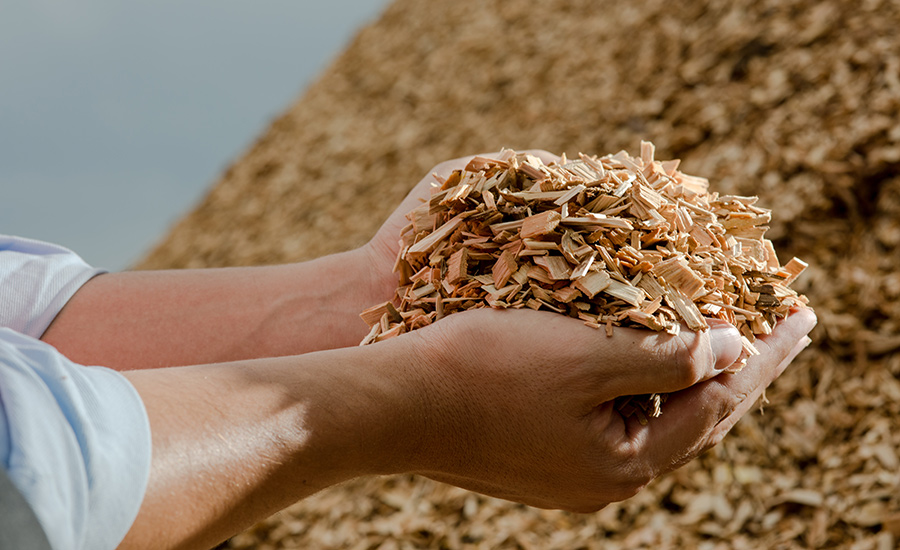
Biomass fuel is controversial due to concerns over carbon sequestration and land use.
The passage of time will reveal more but, again, David has questioned the green credentials of the proposed fuel. He said: ‘What Formula 1 is proposing to do is analogous to sustainable aviation fuel – to make octane from a non-fossil source of carbon.’
‘[To do this], you can use biomass or “synthetic”, which basically means distillate plastic waste. It is effectively using fossil carbon that was used for something else; so, it doesn't make the situation any worse, but neither does it really contribute to lowering emissions. It’s just short-cycle carbon.’
Freight with difficulty
The mention of aviation is pertinent when it comes to Formula 1. The emissions generated by the 10 teams’ vehicles across 21 Grands Prix, including races and testing, account for just 0.7% of Formula 1’s total emissions. But by far the biggest contributor to its CO2 emissions are logistics – the movement of equipment from venue to venue by land, sea, and air.

The equipment used in Formula One must be transported from continent to continent by sea, land, or air.
After that comes business travel at 27.7%, which includes the air and ground transportation of all individuals, as well as the hotel footprint from all Formula 1 teams’ employees and major event staff. So, it’s clear that the main environmental problem isn’t the fuel used during the races; it is all of the other transport emissions.
To be fair to Formula 1, the sport has made an effort to make operations greener, including powering its offices using 100% renewable energy and taking measures to make freight more efficient.
However, any claims that it is motoring to Net-Zero by 2030 need to be chased with a liberal swig of scepticism. A Net-Zero 2030 goal provides a nice headline, but how you get there is the story.
05 July 2022 |
|
|
Sustainability & Environment
The wild weather fluctuations wrought by climate change are stressing out our plants. Our resident gardening expert, Professor Geoff Dixon, explains how.
Pests and diseases are familiar causes of plant damage and loss. Less familiar, but becoming more frequent, are stresses resulting from environmental causes.
These are termed abiotic stresses because no living organism is involved. This means there are no visible signs of pests or pathogens. Diagnosis and treatment are, therefore, less straightforward. These causes are a result of interactions between the plant genotype and the prevailing or changing environment.
Damage may only become apparent after harvesting and at the point of consumer use. A typical example of this is internal browning or breakdown of Brussels sprouts. Larger sprouts are more susceptible to stress, with dense leaf packing in the bud, particularly in early and midseason cultivars.

The internal browning of Brussels sprouts is a consequence of plant stress.
A suggested cause is water condensing within the bud, which restricts calcium transport and leads to marginal leaf necrosis (death). This resembles the exudation, or perspiration, of water from leaf edges when growing plants absorb excessive water, flooding the vascular systems following very heavy rainfall and hot weather.
Moisture damage
Oedema is another moisture-induced disorder. Symptoms include unattractive wart-like swellings coalescing on leaves and stems, particularly on Brussels sprouts, cabbages, and cauliflowers. These may rupture, becoming corky with a yellowish or brownish appearance.

Moisture-induced damage to cabbage leaves.
These symptoms result from high soil moisture content and high relative humidity associated with hot days and cool nights. Both internal browning and oedema can be minimised by improving soil structure, encouraging rapid drainage by deep cultivation or growing plants on raised beds.
Improving soil structure is becoming an important way to control salt accumulation. Soil structure can be badly damaged by flooding that brings in polluted water. In subsequent vegetable and fruit crops, plant water uptake, nutrient use efficiency, and photosynthesis are all impaired. The effects are seen in poor germination, burnt leaf margin, stunting, and wilting. This damage will be particularly severe with highly organic soils.

Salt accumulation in onion crops. Improving soil structure is one way of addressing this problem.
Abiotic disorders are becoming more common in commercial crops and this is likely to be reflected in gardens and allotments. That is an effect of climatic change, with generally hotter and wetter conditions interspersed by droughts and freezing events.
As a result, plant growth is erratic and exhibits abiotic disorders. Plant breeders, especially in Asia, are actively seeking genetic solutions that will create crops capable of withstanding erratic environments. In parallel,the agro-chemical industry is producing environmentally sustainable compounds and biostimulants to help combat these problems.
>> How else has climate change changed the way our gardens grow, and what can be done to alleviate its effects? Geoff Dixon explored this issue further.
Professor Geoff Dixon is author of Garden practices and their science, published by Routledge 2019.
24 June 2022 |
|
|
Careers
Dr Yalinu Poya Gow’s eventful career has taken her from Papua New Guinea and China to Glasgow, with an impressive array of awards collected along the way. She spoke to us about her successes, overcoming challenges, and feeding the world’s growing population through ammonia synthesis.

Dr Yalinu Poya Gow
Tell us about your career path to date.
I was born and raised in Lae, Morobe Province, in Papua New Guinea. I did all my schooling there, then moved to Port Moresby, the capital, to do my university studies. I attended the University of Papua New Guinea and graduated in 2011 with a Bachelor’s Degree in Science, majoring in Chemistry. After graduation, I worked at the Porgera Gold Mine in the pressure oxidation circuit as a Process Technician.
In 2014, I moved to China and did a Master’s in Inorganic Chemistry, majoring in Heterogeneous Catalysis, and received the Outstanding International Student award. In Autumn 2016, I was accepted into the University of Glasgow and began my PhD in Chemistry, majoring in Heterogeneous Catalysis.
I completed my PhD studies December 2019 and graduated in June 2020. My PhD research was on making catalysts suitable for small-scale ammonia production, such as on a farm. Ammonia is a simple compound that is primarily used to make synthetic fertilisers to grow food to feed 40% of the world population; as a result, there is great interest in sustainable ammonia production on a small-scale.
I have received a total of 18 awards and honours in relation to my PhD work, including: the 2020 Commonwealth Chemistry award winner in Green Chemistry; the 2019 Green Talent Award from the German Ministry of Education and Research; and the Plutonium Element Award by International Union of Pure Applied Chemistry (IUPAC) as one of the top 118 chemists in the world under the age of 40; and first place in a Society of Chemical Industry PhD Student Competition.
My research has been highlighted and featured by the American Chemical Society, Scottish Funding Council, Society of Chemical Industry and QS Top Universities. In addition, I have been honoured by the University of Glasgow for my ammonia synthesis research and named 2020 University of Glasgow Future World Changer.
Which aspects of your work motivate you most?
The aspect of my job and research that motivates me the most is contributing to a greater cause. I play a role in contributing towards improving the livelihoods of billions across the world. I am also an educator, teaching students across the world, so in a sense I am developing the world’s human resource: equipping scientists and engineers into bettering themselves and the world. This is my motivation.

Ammonia synthesis research is key in helping us feed the world’s rapidly growing population.
What personal challenges have you faced and how have you overcome them?
The personal challenge that I face is being undervalued. I, as a scientist, am usually overlooked. You see, everyone talks about sustainability, climate change, and what we should do to overcome these challenges, but when it comes to getting the job done, young scientists like me who have a lot to offer are being overlooked by institutions and organisations despite meeting criteria.
The thing with me is that I came the hard way, I worked extremely hard to get where I am and do not sway from paths nor give up easily. I continue to grow in my passion in science and research despite the limited opportunities. I believe all good things come to those who work hard and are patient.
>> We have spoken to many amazing women chemists. Read more about Dr Anita Shukla and the drug delivery systems she is developing.
What is the greatest future challenge for those in your industry and at home, and how could these be addressed through your work?
The greatest challenge is the lack of opportunities. Catalysis is somewhat a niche field when it comes to research fellowships, industrial jobs, or anything in between. Catalysis can help solve some of our problems, but it is often overlooked. Ammonia synthesis is a testament to how catalysis feeds 40% of the world population. When you take into account the UN 2030 Sustainable Development Goals and the world’s growing population, ammonia synthesis should be highly worthy of consideration.
It is the same in where I come from. Papua New Guinea and the Pacific Islands have brilliant and naturally gifted people. The only challenge is the lack of opportunities and services.
Which mentors have helped you along the way and how did they make a difference?
Mentors that have helped me along the way were my parents, who always believed in my potential, instilled in me hard work and discipline, and always reminded me that I have a purpose. I also have had the support of my science teachers at school, undergraduate lecturers and postgraduate supervisors. They are all heroes and heroines of science and have shaped my life greatly!
What is the current state of play within your sector with respect to equality, diversity, and inclusion – and is enough being done to attract and retain diverse talent?
I am a Pacific Islander woman in Chemistry. I am a minority in the world and more so in my field. Opportunities should be given to us as we do not just represent ourselves, we represent an entire people of the Pacific.
That is the whole reason why I wanted to do a PhD in Chemistry with an underlying theme of sustainability, so I can give something back and help my people because they are the ones who face the drastic effects of climate firsthand.
Many people speak of inclusivity on paper, but it needs to come into fruition. Inclusivity is not just a box to tick. There is so much diverse talent out there – brilliant, and qualified people from minority ethnicities.
Is there any advice you would give to young professionals and young people from Papua New Guinea?
Never give up – that is all. Where you come from, your past or present, status in life, background, gender, age, what you look like, these should not hold you back from achieving your goals. Yes, life is hard, but you have a purpose.
Some have it easy, most of us have it hard, but we are tough and resilient people. Eventually, you will reach your goals one day, look back and see that all the hardship faced along the way was totally worth it.
>> Interested in a career in science communication? Then read Suze Kundu’s story.
05 May 2022 |
|
|
Sustainability & Environment
Re-using waste materials and converting them into chemicals will help us create a closed-loop system. Ahead of the SCI Engineering Biology symposium on 23 May, Martin Hayes, Biotechnology Lead at Johnson Matthey, spoke about some exciting approaches and the challenges involved in making the low-carbon transition.
The journey to Net Zero is well underway, with a number of countries already committed to Net Zero by 2050. To achieve this ambitious goal, companies and governments must take a new approach to waste, shifting from linear processing to a circular model.
This involves recycling and reusing products to create a closed-loop system that uses fewer resources and reduces waste, pollution and carbon emissions. As we journey towards Net Zero, these ‘circularity’ principles are increasingly embedded in the research and design of products.
Re-using waste from chemical processes
As a leader in sustainable technologies, Johnson Matthey (JM) is striving to help the chemical industry transition. Martin Hayes, Biotechnology Lead, explains: ‘More and more companies are starting to move away from linear chemical processes to circular ones, which is definitely a step in the right direction.
‘They’re looking at how the waste from chemical processes may be the source for biological processes. Biological entities such as enzymes or organisms can even recover precious metals from waste streams, maximising value while reducing waste.’
>> How are young chemists tackling climate change? Read more in our COP26 review.
In other cases, gas fermentation can upgrade waste products, particularly carbon dioxide and hydrogen, and convert them into chemicals. Hayes explains: ‘In this instance JM joins biology and chemistry to get the desired end product without affecting the customer experience, but making the process much cleaner.’

Fermented food waste could be converted into chemical building blocks.
Food waste is another contributor to greenhouse gas emissions. A circular approach may consider fermenting food waste to convert it into useful chemical building blocks. ‘What is valuable about this is that these chemicals are not produced from virgin fossil material,’ he adds.
Collaboration and feedstock issues
To realise the potential in these technologies and new businesses, it’s important to take a collaborative approach and for multi-disciplinary teams to work together. Hayes continues: ‘We know that getting the biology to the end product requires engineers, chemists, microbiologists, and biochemists – different scientists working together with commercial expertise to make a product that is sustainable, has a low environmental footprint, and is still profitable.
‘We work collaboratively in partnership because we recognise we need to develop these solutions in ways that reflect the needs of each client and the broader society.’
But the scale of the issue shouldn’t be underestimated. On the one hand, those biological entities will require engineering to become efficient catalysts, working selectively with less-than-ideal feedstocks under demanding reaction conditions. On the other hand, scaling up and optimising processes such as fermentation can be resource intensive and involve large volumes.#

Johnson Matthey will be Platinum sponsors for the upcoming Engineering Biology symposium | Editorial image credit: Casimiro PT / Shutterstock
This type of catalyst customisation and process intensification calls for a multi-disciplinary team: bioinformaticians, molecular biologists, chemists and chemical engineers working together.
While the UK leads in renewable technologies, it is also important to think in terms of connected systems rather than isolated applications of technology. That broader perspective in a circular system will get us towards Net Zero and is embodied by the SCI’s symposium on Engineering Biology with which JM is proud to be associated as a (fittingly) Platinum sponsor. This is a topic which is entirely consistent with, and supportive of, JM’s vision of a cleaner, healthier world.
>> Sign up here for SCI's Engineering Biology – applications for chemistry-using business on 23 May.
>> How do we move to non-fossil fuel feedstocks? Here’s our report on the Parliamentary & Scientific Committee Discussion Meeting on 28 March.
03 May 2022 |
|
|